
Every swim lesson has that one kid standing at the wall, goggles dangling around their neck, arms crossed, refusing to go underwater.
Nine times out of ten, it’s not the water. It’s the goggles. They leak. They fog. They rip the hair. Or they’ve been cranked so tight they leave red pressure rings around the eyes for an hour after the lesson ends.
I’ve coached enough kids to know that the difference between a child who loves putting their face in the water and one who dreads it often comes down to whether their goggles actually fit.
The American Academy of Pediatrics recommends eye protection in chlorinated pools – and a pair that fits correctly is the only pair that actually provides that protection.
A better fit won’t solve everything. But it can eliminate a lot of the battles before they start.
🏊 Quick Summary – Key Takeaways
- The suction test is the only real fit check – if it doesn’t hold without the strap, the size is wrong.
- Tightening the strap doesn’t fix a bad seal – it makes it worse and leaves marks.
- Bungee straps save long hair – silicone straps are the main culprit behind hair pulling and goggle refusal.
- For toddlers under 4, a swim mask is usually more comfortable than traditional in-socket goggles.
⚠️ Safety Disclaimer & Target Audience
Best for: Parents of swimmers aged 2 to 12 – from first lessons to recreational swim team.
Coach’s reminder: At early ages, comfort matters more than a perfect waterproof seal. A child who tolerates their goggles is making more progress than one wearing perfectly fitted goggles they refuse to put on.
Why Tight Straps Make Kids Hate Goggles
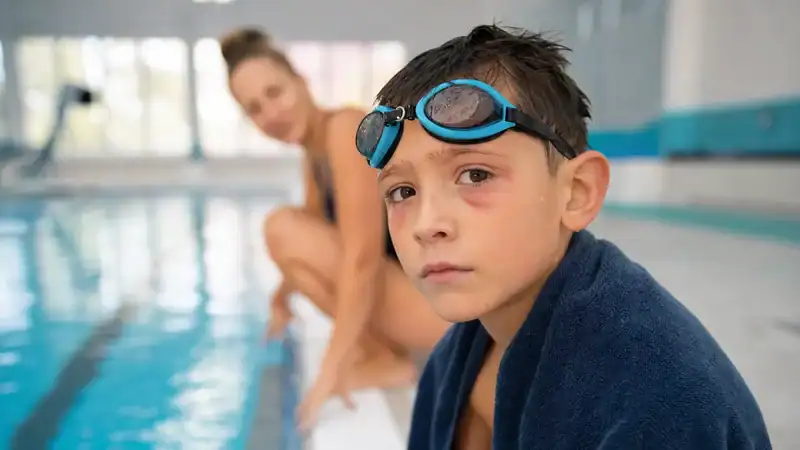
Here’s the thing most parents get backwards: the strap is not what keeps water out.
The silicone gasket – the soft ring around each lens – is what creates the seal. It works by pressing snugly against the curve of the eye socket, creating a vacuum. When the shape of the gasket matches your child’s face, it seals on its own.
When it doesn’t match, no amount of strap tension will fix it. The gasket distorts, the seal breaks, water gets in.
The parent cranks the strap tighter. The goggle digs in harder. The seal still breaks. And now the kid has red pressure marks on their face and hates wearing them.
As Duke Eye Center notes, children’s eyes are particularly sensitive to chlorine exposure – which makes a properly fitting goggle, not a tight one, the right answer.
The fit problem isn’t about effort. It’s about shape.
Step 1 – Find the Right Size With the Dry Suction Test
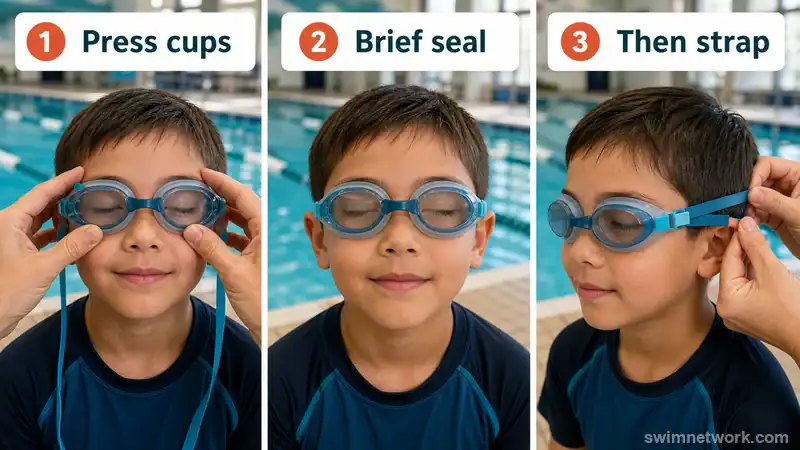
The single most useful thing I ever showed a swim parent is this test – and it takes about ten seconds.
Take the goggle lenses – no strap involved – and press them gently against your child’s eye area. Just the cups against the face. Hold for a second, then let go.
If the silicone gasket is the right shape for your child’s eye socket, the lens will hold a light suction for a beat or two before falling off. That momentary stick is the gasket doing its job.
If the cup falls off immediately – before you even have time to release – the shape is wrong. No amount of tightening will change that. Try a different size or brand.
This is what I call the dry suction test, and it’s the fastest way to rule out goggles that simply won’t seal on your kid’s face, no matter what you do with the strap.
📹 Video Quick Recap:
- Apply the lenses to the face first, before ever touching the strap – this creates the initial seal.
- The strap should only hold the seal in place, not create it.
- A goggle that requires strap force to seal is a goggle that doesn’t fit.
The “Eyes First” Pre-Seal Method
Once you’ve confirmed the seal, put the goggles on your child at home before the first pool session.
Press the lenses to the face first. Then bring the strap over and snug it just enough to hold – not tighten.
The goal is to arrive at the pool with the gasket already pressed into place, so when they put their face in the water, there’s no moment where the seal gets broken before it sets.
Kids who’ve had leaking issues often flinch when they hit the water because they’re expecting it. This method removes that surprise.
Step 2 – Stop Hair Tangles With the Right Strap
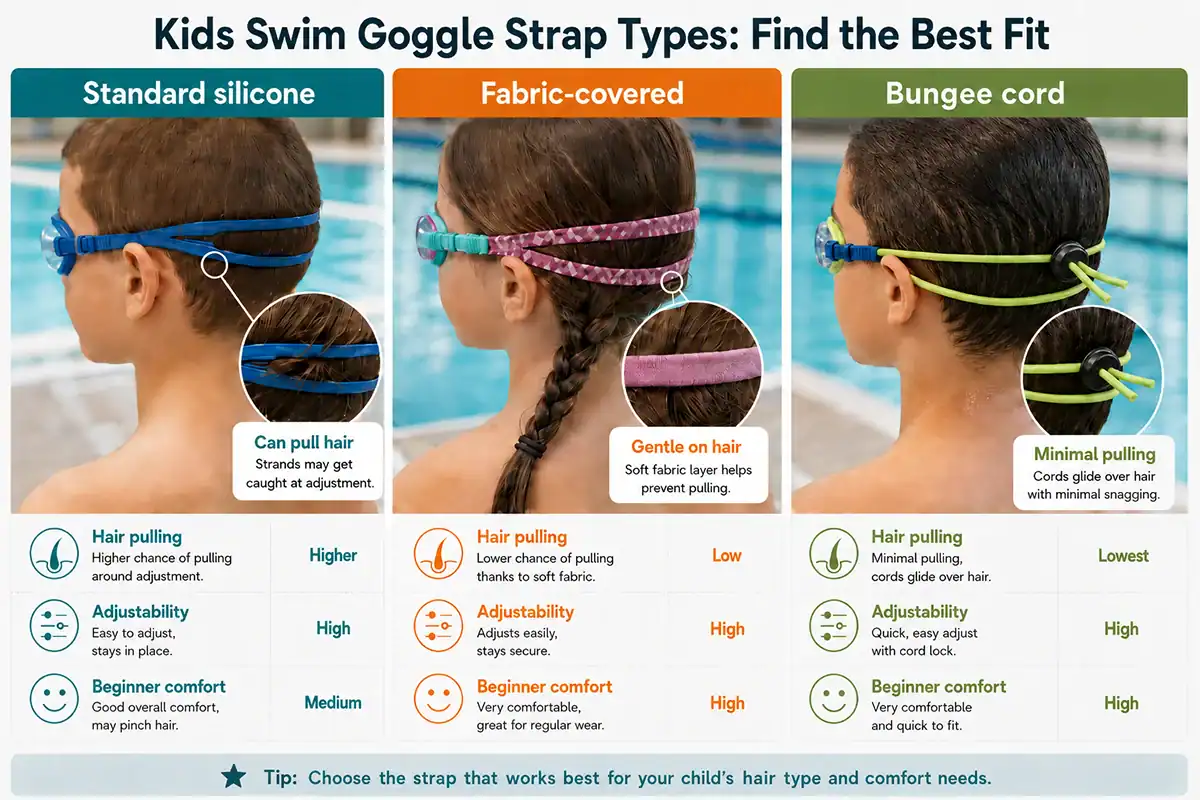
If your daughter comes home with goggle-tangled hair and announces she’s never wearing them again, the problem isn’t the goggles. It’s the strap type.
Standard single silicone straps are the most common, and the most likely to grab and pull long hair. The silicone material catches individual strands, and when you pull the strap off, it drags them with it.
Here’s what actually works:
Split silicone straps divide the strap into two thinner bands that sit higher and lower on the back of the head. They spread the contact area so no single point drags through the hair as severely. Many kids’ racing-style goggles include this design.
Fabric-covered straps are gentler on fine hair and toddler-sensitive scalps. They feel more like a soft headband and are common on beginner and leisure goggles for young kids.
Bungee strap conversions are my personal recommendation for kids with long hair or braids. A bungee strap is an aftermarket elastic cord that replaces the original silicone strap entirely.
It adjusts in seconds with a simple cord lock, it doesn’t grab hair, and because the tension is distributed evenly, it tends to hold the seal better too.
If hair pulling is the reason your child hates goggles, try switching the strap before switching the goggles.
Step 3 – Adjust the Nose Bridge for a Pain-Free Fit
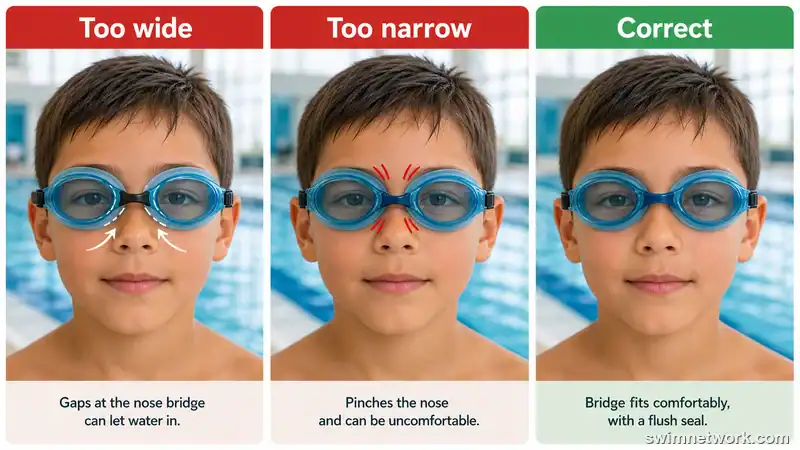
Most kids’ goggles come with two or three interchangeable nose bridge pieces in the box. This is one of the most overlooked fit tools parents never use.
Here’s how to read the fit:
Nose bridge too wide: The goggles sit far apart on the face. The inner edges of the lenses don’t sit flush – there’s a gap near the bridge of the nose.
This is usually where water sneaks in first. The lenses point slightly outward instead of straight ahead.
Nose bridge too narrow: The goggles press together too tightly. Your child feels pinching or pressure on the bridge of the nose. The strap looks like it’s angled down instead of sitting flat.
Correct fit: The lenses sit centered over both eyes with the nose bridge resting comfortably – no pinching, no gaps. From the front, the goggles look symmetrical. The child can look straight ahead without the lenses rotating.
Swap in the smaller nose piece first if you’re seeing leaking near the inner corners. If you’re seeing pinching, go wider. Most kids need the smallest or middle option.
For a deeper look at why leaks persist even after swapping the bridge, our guide on how to fix leaking swim goggles by checking the seal walks through the full diagnosis.
Step 4 – Lock It Down With the 45-Degree Strap Rule
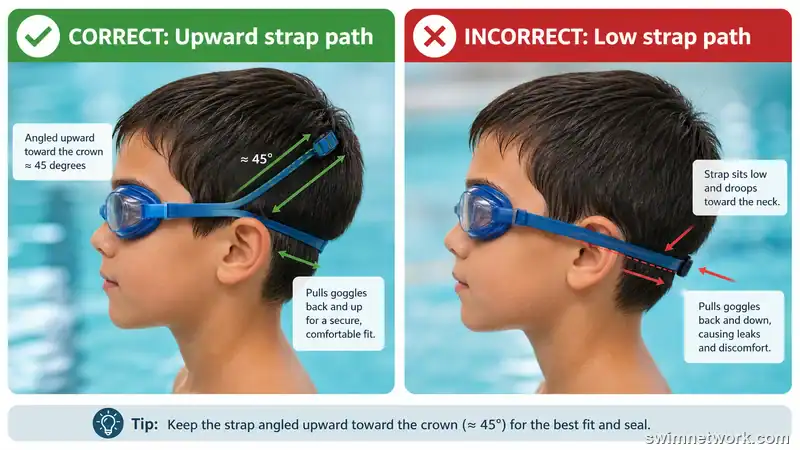
Here’s the strap placement mistake I see constantly on the pool deck: the strap is sitting flat across the back of the head, low – almost at the base of the skull.
That strap position pulls the goggles down and away from the face. The lower the strap sits, the more it acts like a lever, prying the top of the lens forward and away from the eye socket.
The correct position: the strap should exit the goggle frame at roughly 45 degrees – angling up toward the crown of the head, not running flat. When you look at the child from the side, the strap should cross the widest point of the back of the head.
This is the one adjustment that sometimes fixes a leaking goggle instantly, with no part changes required.
📹 Video Quick Recap:
- The strap sits high – toward the crown of the head, not the base of the skull.
- After placing the strap, press the lenses gently to reset the seal.
- Over-tightening moves the strap position down; snug is enough.
Step 5 – Pick Masks or Traditional Goggles for Toddlers
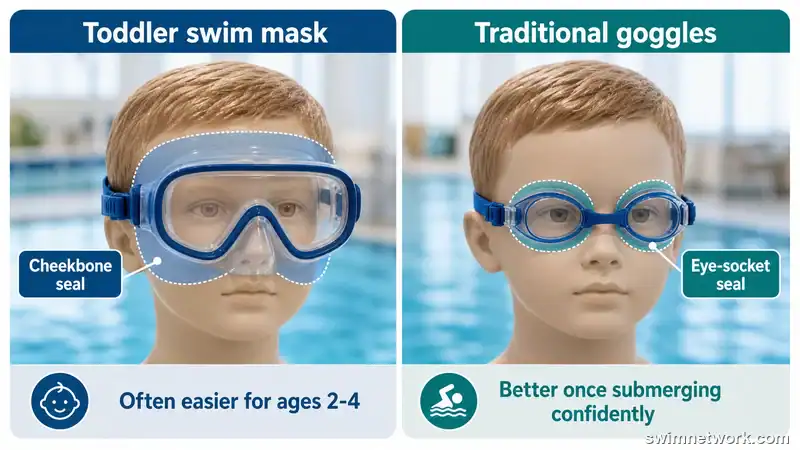
If you’re working with a child under four, the standard in-socket goggle may simply be the wrong tool.
Traditional goggles seal against the eye socket. For toddlers, that suction feeling can be alarming – especially the first few times. It can trigger panic and instantly end the session.
Swim masks are a different design. They sit on the cheekbones rather than in the eye socket, cover a wider area of the face, and feel much less claustrophobic.
The pressure is distributed more broadly, and most toddlers adapt to them faster than to traditional goggles.
The tradeoff is that masks don’t seal as tightly as a well-fitted traditional goggle – but for a 2-to-4-year-old who’s still getting comfortable with water on their face, that’s usually an acceptable tradeoff.
My general guideline: masks for toddlers working on basic comfort, traditional goggles once the child is confidently submerging on their own. That transition usually happens somewhere between ages 4 and 6, depending on the child.
Step 6 – Stop Fog Without Ruining the Lenses
One question I get almost every season: “Why do the anti-fog lenses stop working after two weeks?”
Usually because someone wiped the inside of the lens.
The anti-fog coating on most swim goggles is a thin, fragile treatment on the inner lens surface. It works by spreading moisture into a thin film instead of letting it bead into droplets.
The moment you touch it – with a finger, a towel, anything – you start removing it. There’s no way to undo that.
The rules:
- Never touch the inside of the lens. Not once.
- Rinse the goggles with cold fresh water after every session and let them air dry. Chlorine continues degrading the coating if it’s left to dry on the lens.
- Store them in a hard case – not loose in the bottom of a swim bag where every other piece of gear scratches the inner surface.
One more lens question that comes up for kids who swim in both indoor and outdoor pools: which tint is right? Clear lenses are generally the better choice for indoor lessons and early-morning training. Our guide on clear vs. tinted lenses for kids swimming indoors and outdoors explains each option and when to switch.
If the anti-fog is already gone, there are sprays and drops that restore some of the effect. We cover all of it in our full guide on how to keep swimming goggles from fogging up.
Frequently Asked Questions About Kids’ Swim Goggles
Should my 2-year-old wear swim goggles?
Yes – but comfort should come before seal quality at that age. A toddler swim mask is usually a better starting point than traditional in-socket goggles. The priority is building confidence in the water, not achieving a perfect seal.
Why do my kid’s goggles keep leaking even when tight?
Because tightening doesn’t fix a shape mismatch. If the silicone gasket doesn’t match the curve of your child’s eye socket, the strap can’t compensate. Try the dry suction test with a different size or brand before adjusting the strap further.
Are prescription goggles worth it for kids?
Absolutely – especially if your child normally wears glasses. Step-diopter prescription goggles are widely available and relatively inexpensive.
A child who can actually see clearly underwater is safer and more confident. The Prescription Swim Goggles Guide covers how to match the right diopter.
Your Kid’s Goggles Should Disappear Into the Background
A pair of goggles that fits properly shouldn’t need daily adjusting. It shouldn’t leave marks. It shouldn’t pull hair or require constant re-sealing at the wall.
Once you’ve found the right size with the suction test, dialed in the nose bridge, and confirmed the strap angle – most parents find their kids stop fussing over goggles entirely.
The gear disappears into the background where it belongs, and the swimming takes over.
When you’re ready to pick a pair based on fit, our roundup of the best swimming goggles for kids covers options across every age and strap type.
Good luck at the pool… and maybe keep a spare pair in the bag just in case. For the broader fit, lens, care, and replacement framework that applies as your child grows, our swim goggle guide for fit and long-term care covers everything in one place.
Disclosure: This article features AI-assisted imagery to help provide a more intuitive and visual reading experience.

 Why Are My Swim Goggles Leaking? Fix the Seal Before You Tighten the Strap
Leave a Reply