
I’ve coached for over a decade, and the most common post-practice complaint I hear has nothing to do with technique. It’s the rings – two red circles stamped around the eyes like a swimmer lost a fight with a pair of suction cups.
Here’s what most people don’t know: there’s a second category of eye protection – the swim mask – and for a lot of recreational and open water swimmers, it’s the smarter choice.
Sound familiar? The debate between swim goggles vs. swim masks isn’t about which is better. It’s about which is right for your face and your water.
🏊 Quick Summary – Key Takeaways
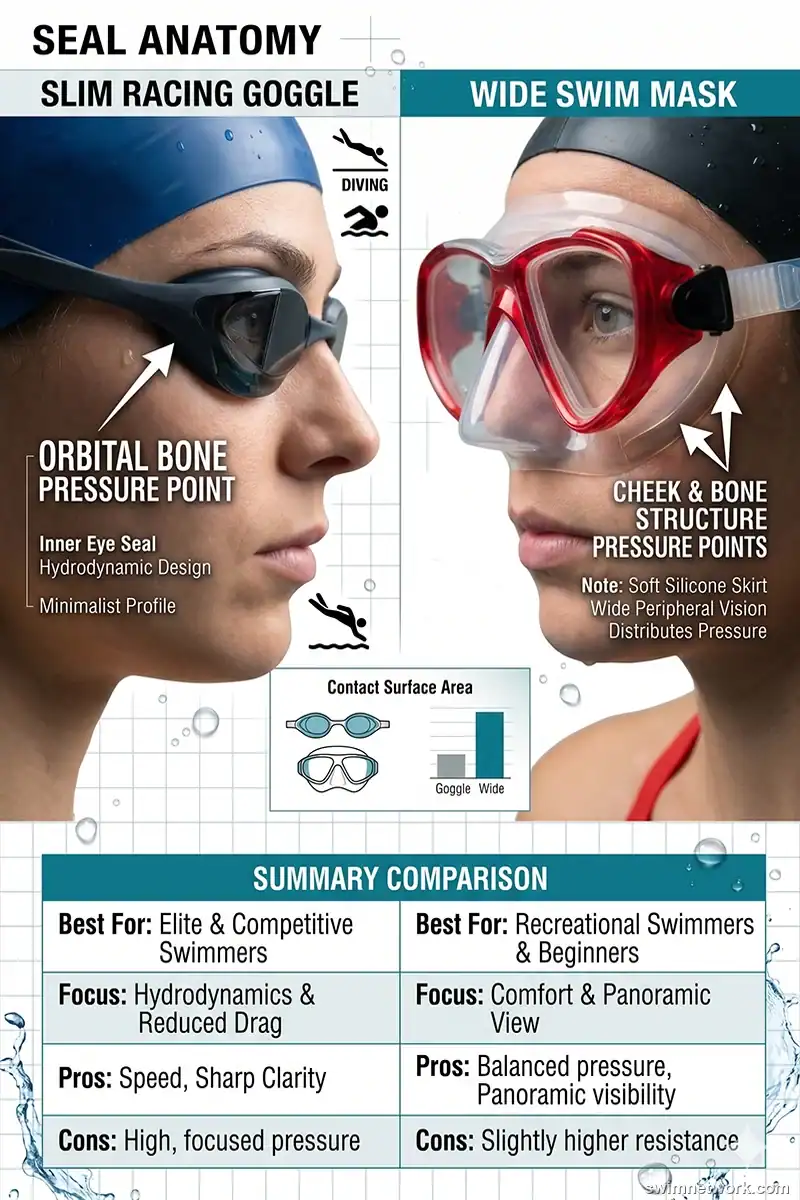
- The Core Difference: Goggles sit inside the eye socket; masks seal on the forehead and cheekbones.
- Best for Speed: Traditional swim goggles minimize hydrodynamic drag for competitive lap swimmers.
- Best for Comfort: Swim masks eliminate raccoon eyes by distributing pressure across a wider silicone skirt.
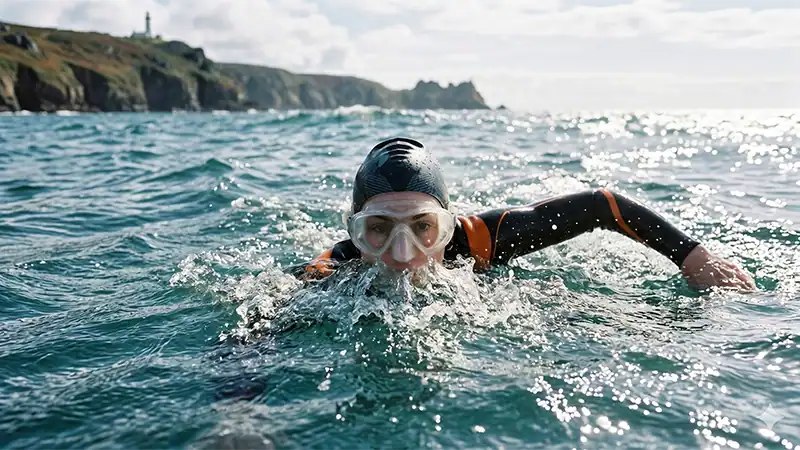
- Open Water Advantage: Masks offer a near-180-degree field of vision – critical for sighting buoys and reducing anxiety.
- The Bottom Line: Neither is universally better. The right choice depends on where you swim and what your face allows.
⚠️ Safety Disclaimer & Target Audience
Best for: Recreational swimmers, open water beginners, lap swimmers dealing with chronic goggle leaks, and anyone who’s ever Googled “why do my goggles leave marks.”
Not the primary focus: If you’re competing in sanctioned pool events where drag rules matter, you’ll almost certainly stick with racing goggles – and this guide will explain why.
Coach’s reminder: No piece of eye gear compensates for poor head position. Fix your stroke first. Then worry about what’s protecting your eyes.
Two Questions to Ask Yourself Before Buying
Before you make a decision, be honest about two things.
Where do you swim most? Pool lanes are a different environment from open water. What works at 5am under fluorescent lights will absolutely fail you in a choppy bay with chop and direct sun.
How has your skin reacted to goggles in the past? If you routinely get deep marks that take hours to fade, that’s not a sign you’re tightening the strap wrong. That’s anatomical feedback – your orbital bone structure may simply not be compatible with standard goggle gaskets.
One more: What’s your primary stroke? Breaststroke swimmers spend more time with their head lifted, which means peripheral vision matters more. Freestyle swimmers keep their face down – drag matters more.
Your answers to those questions will make the rest of this guide obvious.
The Real Reason Your Face Hurts After a Long Swim
Standard swim goggles work on a specific mechanical principle: a small silicone gasket creates a low-pressure seal directly against the skin surrounding your eye socket.
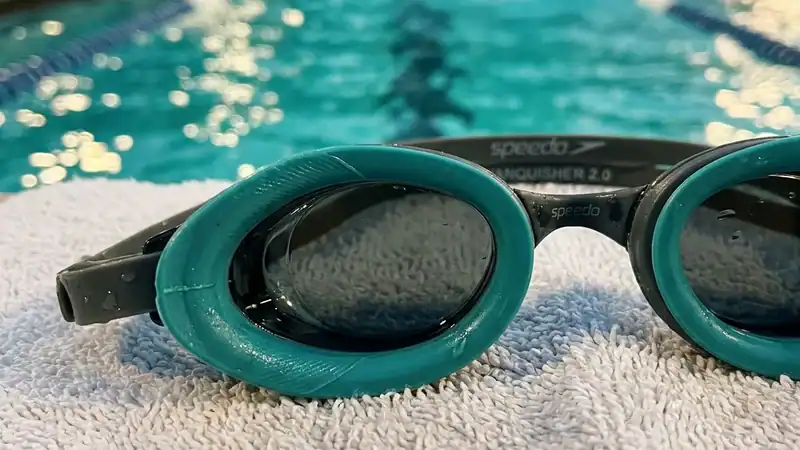
That works for most faces. But not all of them.
As Outdoor Swimmer’s detailed breakdown of goggles vs. masks explains, the fundamental trade-off is between seal precision and pressure distribution. Goggles win on precision. Masks win on distribution.
Why Tiny Silicone Gaskets Cause Lasting Bruises
The skin directly around the eye socket – what anatomists call the periorbital area – is among the thinnest on the human body, measuring less than 1mm in most areas.
When a goggle gasket presses against it for 45 minutes or 90 minutes, the sustained low-pressure suction can displace fluids and restrict blood flow in the soft tissue, compressing superficial capillaries. That’s what causes the redness.
On some faces, it’s mild. On others – particularly those with shallower eye sockets or very fine skin – it becomes a bruise that takes hours to fully resolve.
Tightening the strap makes it worse, not better. A tighter strap increases the suction.
More tension. More bruising. The real fix isn’t pressure – it’s a completely different seal geometry.
A Larger Skirt Means Your Cheekbones Bear the Load, Not Your Eye Socket
A swim mask uses a completely different sealing approach.
Instead of a small gasket pressing into the orbital area, a mask features a wide silicone skirt that spans from the lower forehead down to the upper cheekbones. The seal lives on sturdier anatomical structures – bone with more tissue cushion – rather than the delicate periorbital skin.
The result is distributed pressure over a larger area. No single spot gets compressed. No deep marks.
💡 Coach’s Tip
If you have high or prominent cheekbones, certain low-profile competition goggles will always leak on you – not because of the strap, but because the gasket geometry doesn’t conform to your face shape.
If you’ve tried three or four different goggle brands and still can’t get a seal… stop blaming the goggle. Start thinking about what a mask might do for you instead.
Pool Sprints vs. Open Water Slogs – They Need Different Tools
This is the section most comparison articles skip.
They’ll tell you goggles are for “competitive” swimming and masks are for “recreational” use, which is technically true but useless. Let me give you the specific mechanics behind that distinction so you can apply it to your actual situation.
The Drag Penalty in Competitive Pool Sessions
Swim masks have a significantly larger front profile than swim goggles.
In open water, that’s irrelevant. In a pool, it starts to matter – specifically at the wall. Every flip turn involves your head leading into the push-off, and a mask’s wider frame catches more water resistance as you drive off the surface.
That drag penalty is small. But over a 5,000-meter practice session involving 100+ turns, it accumulates.
This is why you’ll never see a mask on a swimmer competing in a sanctioned pool event. For lap training at moderate intensity – the 80% of recreational swimmers who are swimming for fitness, not shaved seconds – it’s close to irrelevant.
Chop, Glare, and No Lane Lines – This Is Where Masks Win
Outside the pool, the math flips completely.
Open water swimming introduces variables a lane line can’t protect you from: chop, sun glare from multiple angles, other swimmers crowding your sightline, and the psychological pressure of not being able to see a wall ahead of you.
A mask’s wider field of vision changes all of that.
📹 Video Quick Recap:
- Goggles are strictly preferred for pool racing due to lower hydrodynamic drag.
- Swim masks deliver a wider peripheral field of view, which is essential for spotting buoys in open water.
- The larger silicone skirt of a mask distributes pressure better during long open-water swims.
- Masks can reduce anxiety for beginners by eliminating the tunnel-vision effect of standard goggles.
Can’t Spot the Buoy? Your Tunnel-Vision Goggles Are Probably the Problem
Standard goggles frame your vision. You see ahead and slightly to the sides – roughly a 120-degree cone.
That’s fine in a pool where the black line runs under you and the wall sits 25 meters ahead.
In open water, you need to know where the turn buoy is, where other swimmers are converging, and whether a boat wake is coming from your left. A 120-degree cone of vision forces you to fully lift your head to gather that information – breaking your stroke rhythm and spiking your heart rate.
The Crocodile-Eye Trick That Elite Open Water Swimmers Use
Elite open water swimmers use what’s called the “crocodile eye” technique: rather than lifting the entire head, they barely breach the waterline with the tops of their eyes – just enough to capture a reference point – then rotate back into the stroke.
With standard goggles, this requires lifting far enough that the goggle lenses clear the waterline. That movement disturbs body position and adds drag.
With a swim mask, the wider lens coverage means you can gather visual data with a shallower head lift. The field of vision is already working in your favor before your head fully clears the surface.
It’s a subtle difference, but over a 3.8km Ironman swim leg, or a recreational ocean swim with 15 buoys to navigate, that subtlety becomes a real tactical advantage.
When Swim Anxiety Is Actually a Visibility Problem
This one is harder to quantify, but I’ve seen it change a swimmer’s relationship with open water entirely.
Several beginner adult swimmers I’ve coached have reported anxiety responses in open water – shallow breathing, elevated heart rate, the urge to stop – that largely disappeared when they switched from standard goggles to a full swim mask.
The psychological mechanism seems to be peripheral visual awareness. When you can see more of your environment, you feel less trapped by it.
It’s not just perception. A wider field of view is genuinely more information about your surroundings – and the nervous system responds to information with calm rather than alarm.
💡 Coach’s Bottom Line
If open water makes you anxious, consider whether tunnel-vision goggles are amplifying that anxiety. A swim mask’s wider field of view can provide enough environmental awareness to calm the physiological stress response – especially for newer open water swimmers.
Try the Dry Suction Test Before Handing Over Your Credit Card
This is the most practical advice I can give you, regardless of which type you’re considering.
Don’t wet-test in the pool first. The dry suction test tells you everything.
📹 Video Quick Recap:
- Mask seals are generally more forgiving for varied face shapes compared to rigid goggle nose bridges.
- If a mask sticks to your face for 3–5 seconds without the strap, the seal geometry is anatomically sound for your face.
- Ensure the mask frame sits entirely outside the orbital bone to prevent pressure points.
- Goggles with adjustable nose bridges allow some customization, but face shape variance still limits how much adjustment helps.
Here’s the test: press the piece against your face without attaching the strap. Inhale lightly through your nose to create light suction. Release your breath and let go.
A well-fitted goggle or mask will stay in place for at least 3 seconds without your hands. If it drops immediately, the seal geometry doesn’t match your face anatomy. Don’t buy it hoping the strap will compensate.
The Inner Corner Drip That Kills Every Flip Turn
For standard goggles, the most common leak point isn’t the main seal – it’s the inner corner, at the bridge of the nose.
If the nose bridge is too wide for your face, the inner corners of the gaskets lift slightly away from the skin. Water enters at the push-off, where pressure is highest.
Adjustable nose bridges solve this for many swimmers. If you’ve been using a fixed-bridge goggle and chronically get water in the inner corners, try an adjustable bridge model before switching to a mask entirely.
The Frown Test Every Mask Buyer Skips
Swim masks have their own failure point: the upper silicone skirt, where it contacts the lower forehead.
Here’s the test nobody runs in the store. Put the mask on. Then make a pronounced frown – furrow your brow, wrinkle your forehead. If you feel the upper skirt lift even slightly, water will find that gap under any real swim effort.
Frowning recruits the corrugator and frontalis muscles, creating small topographic changes in the forehead surface. The mask skirt needs to stay compliant against those changes.
Stiffer silicone skirts fail this test. Softer, thicker skirts pass it. This is worth five seconds in the swim shop.
You’ve Got the Info – Now Make the Call
At this point, you’ve got enough information to make a decision that fits your situation – not a generalized recommendation.
If you’ve decided that goggles are still the right tool, our guide on how to choose the perfect swimming goggles goes deep on fit, lens types, and nose bridge selection.
If you’re heading into open water – whether for triathlon, ocean swimming, or just exploring – check out our open water swimming gear beginner’s guide for a full breakdown of what you’ll actually need.
And if you’re ready to shop with confidence, our curated breakdown of the 22 best swimming goggles covers every category – training, racing, open water, and prescription – so you can find the right pair without the guesswork.
Your Face Already Gave You the Answer
There’s no universally “best” choice between swim goggles and swim masks.
There is, however, a best choice for your face shape, your primary swim environment, and your relationship with pressure against your skin.
Goggles are the right call for competitive pool training, distance lap swimming, and anyone whose face seals cleanly against a small gasket without lasting marks.
Masks are the right call for open water navigation, recreational snorkeling sessions, high-cheekbone anatomy that leaks every goggle, and swimmers who need wider peripheral awareness to feel safe in open water.
Stop trying to look like an Olympian if what you actually need is to finish a swim without raccoon eyes. Pick the tool that lets you focus on the water, not what’s pressing against your face.
If goggles are your answer and you’re ready to find a pair that seals correctly, our full swim goggle selection guide — fit, seal, and care covers the complete process in one place.
Disclosure: This article features AI-assisted imagery to help provide a more intuitive and visual reading experience.

 Which Swim Goggle Lens Type Do You Actually Need?
Leave a Reply