
I spent my first three years of Masters swimming squinting at a blurry black line at the bottom of the pool, guessing when the wall was coming.
I’d ordered prescription swim goggles – twice – and both pairs felt wrong. One left me dizzy after a 400. The other was so underpowered I could barely read the pace clock from lane four.
The problem wasn’t the goggles. It was that I had no idea how to convert my glasses prescription into the right diopter for a swim goggle. Nobody told me the math is different. Nobody mentioned astigmatism changes everything.
This prescription swim goggles guide fixes that. Five minutes and a copy of your eye prescription is all it takes… honestly, that’s it.
🏊 Quick Summary – Key Takeaways
- What you’ll learn: How to read your glasses prescription and calculate the correct diopter strength for off-the-shelf swim goggles.
- Time to see results: Five minutes of math before your next order.
- Difficulty level: Beginner – no optometrist visit needed.
- Key equipment needed: A recent copy of your eyeglasses or contact lens prescription.
⚠️ Safety Disclaimer & Target Audience
Best for: Adult fitness swimmers, Masters swimmers, and triathletes dealing with myopia or mild astigmatism.
Skip if: You have complex optical needs – high astigmatism, keratoconus, or a post-surgical cornea – and need a specialized professional consult before buying any corrective eyewear.
Medical note: This guide is educational information only. It is not medical advice. If you experience persistent headaches, eye strain, or blurred vision after wearing prescription goggles, stop using them and see an optometrist. And please – never wear contact lenses under standard swim goggles. The infection risk is real, and the consequences can be permanent.
Before We Do the Math, Grab These Numbers
Before you touch the diopter dropdown on any goggle website, you need one document: your current eyeglasses prescription.
Not your contact lens prescription. Your glasses prescription. They use a different measurement system, and your glasses Rx is what maps directly to goggle diopter power.
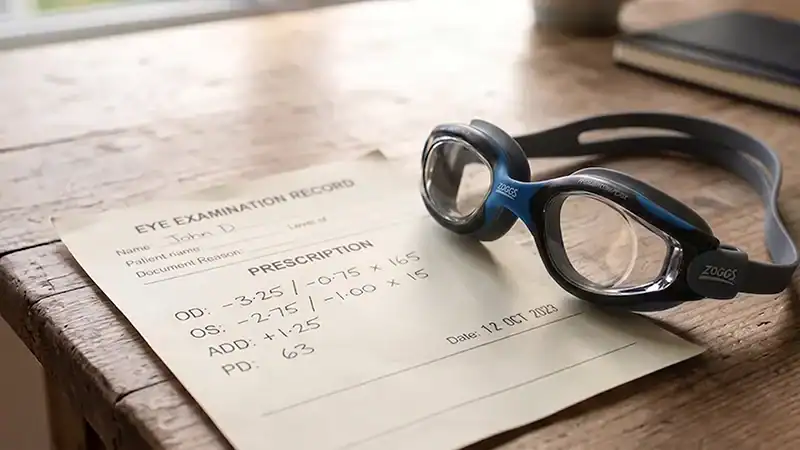
Pull it up – physical card, email from your optometrist, or your online patient portal. You’re looking for two specific columns:
- SPH (Sphere): This is your main correction power. A minus sign (−) means you’re nearsighted (myopic). A plus sign (+) means you’re farsighted.
- CYL (Cylinder): This is your astigmatism correction. If this column is blank or shows 0.00, you have no significant astigmatism – your calculation just got a lot simpler.
You’ll see these listed for your right eye (OD) and left eye (OS) separately. Note them both down. Most swim goggles let you choose a different diopter per lens.
Why Your Everyday Glasses Prescription Isn’t Enough
Here’s the mistake I made both times I ordered: I looked at my SPH, which was −3.50, and bought −3.50 goggles. Felt logical. Wasn’t.
There are two reasons your glasses prescription doesn’t translate directly to swim goggles.
First, if you have astigmatism, your glasses prescription has a CYL and AXIS value correcting for it.
Standard off-the-shelf swim goggles – what the industry calls step-diopter goggles – are spherical lenses. They correct for myopia or hyperopia, but they cannot correct for a cylindrical axis. That CYL correction gets lost entirely.
Second, water’s refractive index (1.33) is significantly closer to the refractive index of the human eye than air is.
This slightly alters how optical power behaves underwater compared to on dry land. It’s a small effect, but it adds to why a straight copy of your glasses Rx won’t feel right behind a swim goggle.
The practical result: you need to do a quick calculation to find your swim goggle diopter – especially if you have any astigmatism at all.
According to the optometry team at Eyes On Eyecare, swimming with contact lenses under standard goggles also carries severe infection risks – including Acanthamoeba keratitis, a rare but potentially blinding parasitic infection associated with contaminated water. Prescription goggles exist for this exact reason. Don’t skip them.
The Math Behind Your Swim Goggle Prescription – Most Swimmers Get This Wrong
The calculation you need is called the Spherical Equivalent. It’s the industry-standard method for approximating diopter strength when your astigmatism can’t be corrected by the goggle lens itself.
The formula is:
Sphere + (Cylinder ÷ 2) = Your Goggle Diopter
That’s it. That’s the whole thing. Let’s walk through it.
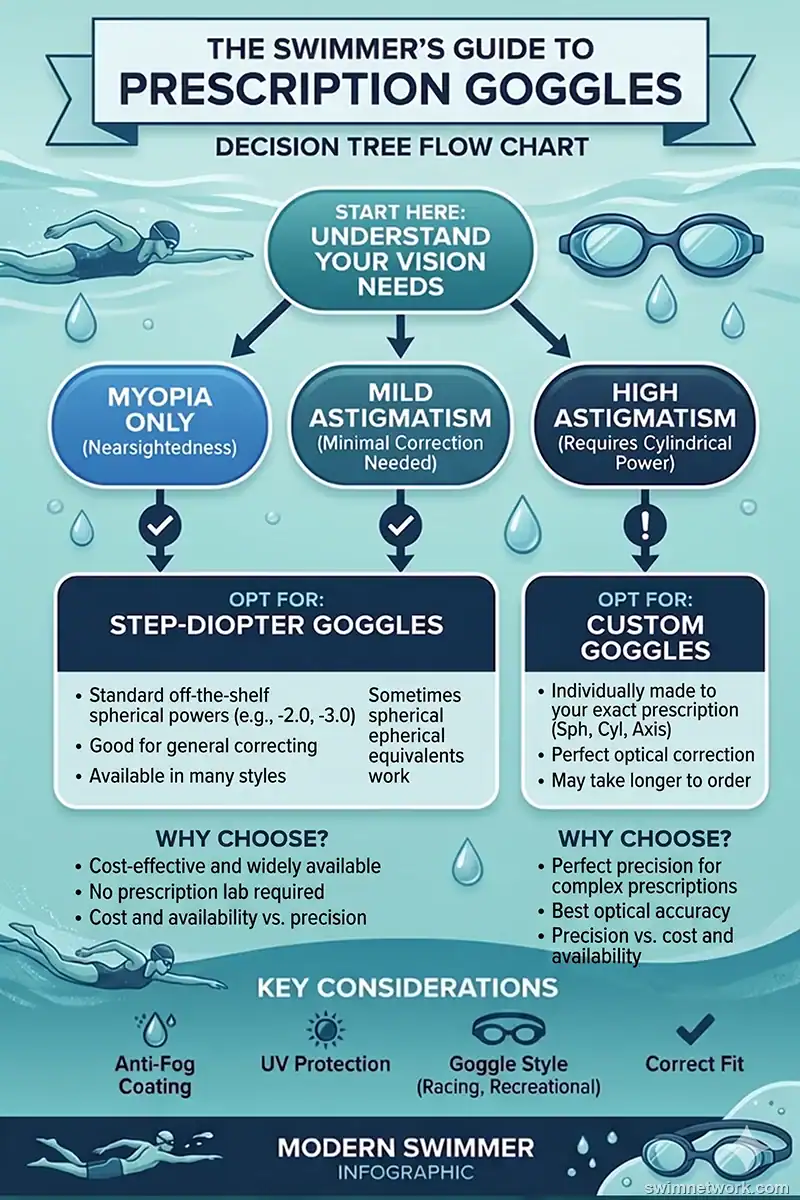
Step One: SPH + (CYL ÷ 2) – Walk Through It With Me
Let’s say your glasses prescription reads:
- OD (Right Eye): SPH −3.00, CYL −1.00
- OS (Left Eye): SPH −2.50, CYL −0.50
Right Eye Calculation:
−3.00 + (−1.00 ÷ 2) = −3.00 + (−0.50) = −3.50
Left Eye Calculation:
−2.50 + (−0.50 ÷ 2) = −2.50 + (−0.25) = −2.75
So you’d be looking for goggles offering approximately −3.50 for your right lens and −2.75 for your left. Most prescription goggle brands let you mix diopters between eyes – a feature worth confirming before you buy.
Sound familiar? Most swimmers I’ve talked to have never been walked through this calculation. They guess, they get it wrong, and they assume prescription goggles just don’t work. They do. The math just needs to be right first.
Where Most Swimmers Screw Up the Calculation
The most common error is rounding up.
Step-diopter goggles come in fixed increments: −1.00, −1.50, −2.00, −2.50, −3.00, and so on. If your calculated Spherical Equivalent is −2.75, there is no −2.75 goggle on the shelf.
Most people instinctively round to the nearest number, which would be −3.00. That’s a mistake.
An overpowered lens strains your eyes during long sets. An underpowered lens is slightly less sharp, but your eye muscles adapt to a weak lens far more comfortably than they fight an overpowered one.
Always round down.
In this example, −2.75 rounds down to −2.50.
💡 Coach’s Tip
If your math puts you at −2.75, buy the −2.50 goggle. A slightly underpowered lens is far easier on your eyes during a one-hour practice than an overpowered one. I’ve watched swimmers quit their prescription goggles over headaches that were entirely caused by going one increment too strong.
When Off-the-Shelf Goggles Just Won’t Cut It
Here’s the hard truth most goggle product pages won’t tell you.
If your CYL value is higher than −1.50 or −2.00, the Spherical Equivalent calculation will give you a number – but the resulting goggle won’t give you genuinely clear vision.
The reason is mechanical: step-diopter lenses are spherical. They correct for near or farsightedness across the whole lens uniformly. They cannot replicate the axis-specific cylindrical correction your glasses lenses provide for astigmatism.
The higher your CYL, the more distortion you’ll experience, even with the “right” spherical equivalent diopter.
For swimmers with high astigmatism (CYL above −1.50), the only real solution is custom prescription goggles – lenses ground specifically to your full Rx, including SPH, CYL, and AXIS. These are available through specialty online opticians who serve the swim market.
They cost significantly more, but if you’ve ever tried step-diopter goggles and felt like the pool was still underwater-blurry even with the “right” diopter – this is probably why.
📹 Video Quick Recap:
- Explains the Spherical Equivalent formula: Sphere + (Cylinder ÷ 2) and why it’s necessary.
- Custom goggles are genuinely better for high astigmatism – not just a marketing claim.
- Water’s refractive index (1.33) affects optical power differently than air, which is why your glasses Rx doesn’t translate 1:1.
- The gap between step-diopter and custom widens significantly as CYL increases.
Decide Between Pre-Made and Custom Without Guessing
Use this as your decision point before you order anything.
| Your Vision Type | The Math You Do | What You Should Buy |
|---|---|---|
| Myopia only (CYL = 0) | Use your SPH directly | Standard Step-Diopter |
| Mild Astigmatism (CYL up to −1.50) | Sphere + (Cylinder ÷ 2), round down | Standard Step-Diopter |
| Moderate-High Astigmatism (CYL > −1.50) | Step-diopter won’t correct fully | Custom Prescription Lenses |
| Farsightedness (SPH +) | Use SPH + (Cylinder ÷ 2), round down | Standard Step-Diopter (if available) |
One more thing worth noting: some brands let you order different diopters for each eye; others offer only matched pairs. If your eyes differ by more than one increment – say, −3.00 on one side and −1.50 on the other – check this before purchasing. A brand that forces matched lenses is not the right option for asymmetric vision.
Perfect Lenses Are Useless If the Gasket Leaks
I want to pause here, because this is the part most prescription goggle guides completely skip.
You’ve done the math. You’ve got the right diopter. You click “buy.” And then the goggles arrive, they fill with water on your first length, and you’re back to blurry lane lines.
Optical correction means nothing if the seal fails. Once the numbers are right, our guide to choosing, fitting, and caring for swim goggles helps you evaluate the seal, lens type, straps, and maintenance before you buy.
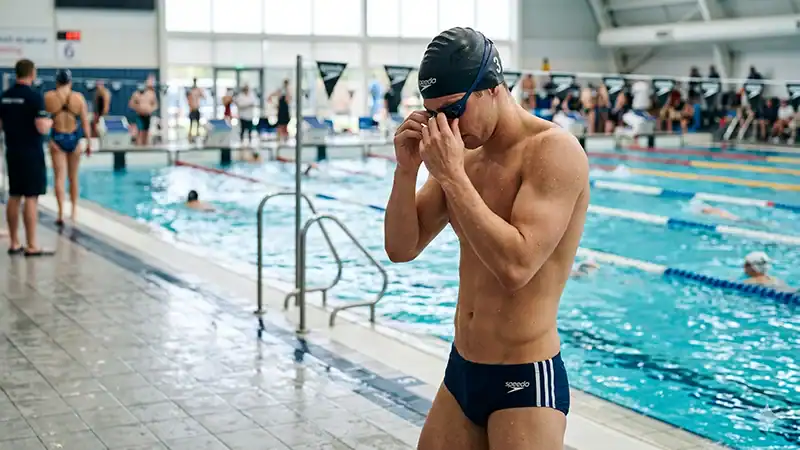
Prescription goggles generally come in the same fit profiles as regular goggles: curved lens, flat lens, wide frame, low-profile race fit. Each of these seals differently depending on your orbital shape and nose bridge width.
Many prescription goggles also come with tinted or mirrored options. If you’re choosing between those, our guide to tint and coating options for prescription swim goggles breaks down which lens color fits which environment – and why UV400 matters even more when you’re correcting vision.
Before you spend more on custom lenses, I’d strongly recommend reading our goggle fit guide – it walks through the dry suction test and how to identify the right frame shape for your face, whether you’re buying off-the-shelf or custom.
And if you’re ready to shop, the best prescription swim goggles roundup covers the top models currently available, with notes on which brands offer mixed diopter ordering and which specialize in custom lenses.
One more: if you swim in open water and have considered a swim mask instead of goggles for the wider field of view, read swim goggles vs. swim masks first. Prescription lenses are available for some mask styles, but the selection is far more limited.
📹 Video Quick Recap:
- Step-diopter goggles are affordable and effective for swimmers with myopia only or mild astigmatism.
- If your CYL exceeds −1.50, off-the-shelf options will likely leave you with blurry edges and eye fatigue.
- Custom prescription goggles from specialty suppliers can match your full Rx including cylinder and axis.
- Fit and seal quality matters just as much as the lens power – a well-sealed cheap goggle beats a leaking premium one.
You Don’t Have to Swim Blind Anymore
Here’s what I wish someone had told me at the start.
The calculation is five steps. You find your SPH. You find your CYL. You divide the CYL by two. You add it to your SPH. You round down to the nearest available diopter.
That’s the difference between three years of blurry lane lines and actually seeing where you’re going.
There’s still the question of fit – and that part takes a bit of experimentation. But at least you’re starting with the right lens power instead of guessing from the product photo and hoping for the best.
Try it. You might be surprised how much faster practice feels when you can actually see the clock.
Disclosure: This article features AI-assisted imagery to help provide a more intuitive and visual reading experience.

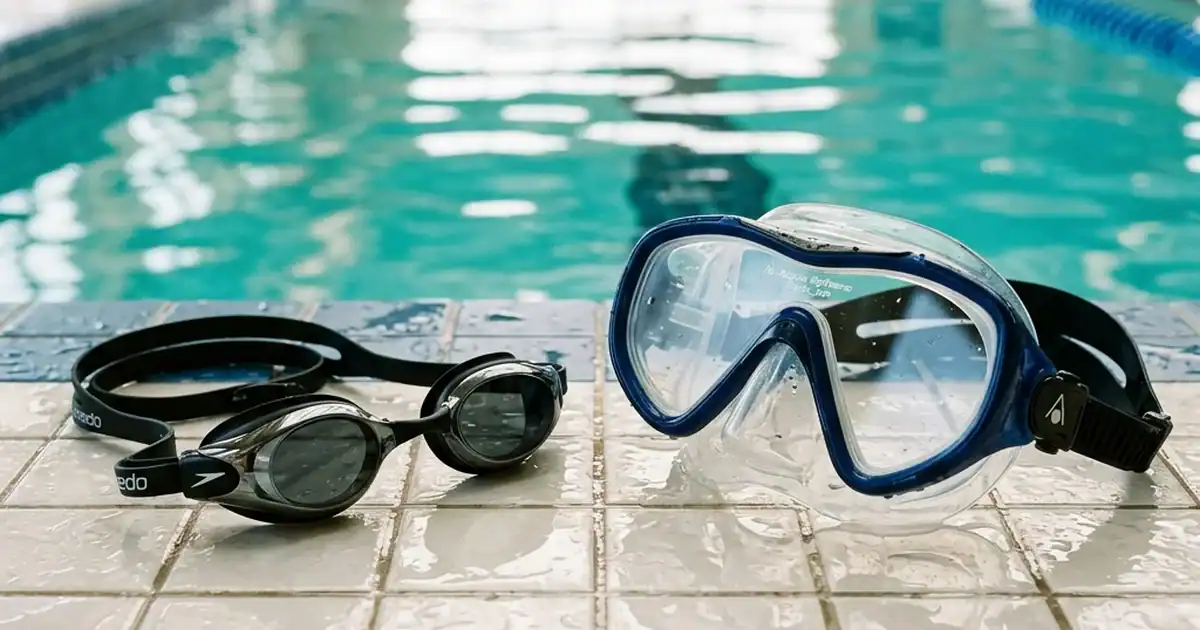 Keep Getting Raccoon Eyes? How to Choose Between Swim Goggles and Swim Masks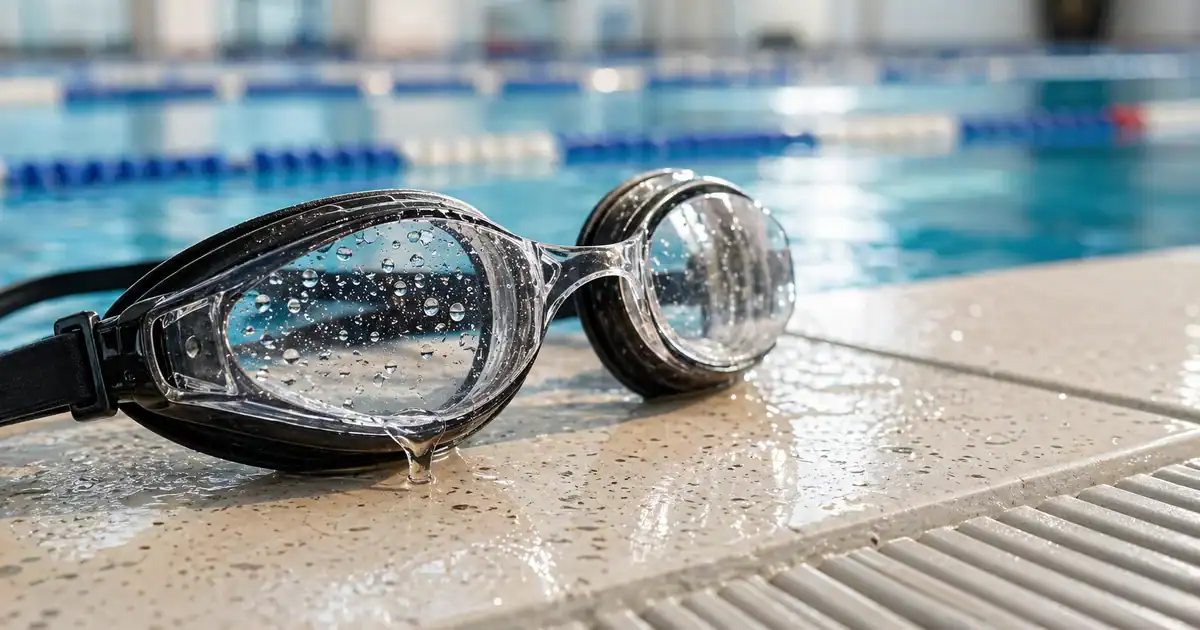
So if you are farsighted sph +2.50 and the cyl is -1.00 you subtract 0.50 to get 2.00?
Yes, that is exactly right! You are using the Spherical Equivalent formula: Sphere + (Cylinder ÷ 2) = Your Goggle Diopter
Applying your numbers:
Take your Cylinder (-1.00) and divide it by 2: -0.50
Add that to your Sphere (+2.50): +2.50 + (-0.50) = +2.00
Since it lands perfectly on +2.00, there is no need to round down. You would look for step-diopter swim goggles with a +2.00 optical lens (make sure you are specifically looking for positive/farsighted lenses, as most standard swimming goggles on the market default to negative/nearsighted lenses).