
You peel off your goggles after a solid workout, glance in the locker room mirror, and stop.
Two deep rings circle your eyes like you lost a round with a pair of pool goggles. Which… technically, you did.
I’ve coached swimmers for years, and goggle marks are one of those things everyone complains about and almost nobody actually fixes – because they’re solving the wrong problem.
If you’ve been loosening the strap and still waking up looking like you work the night shift, this is the piece you’ve been missing. Here’s how to avoid goggle eyes with five fixes that address the root cause – starting with the one thing most swimmers never do.
🏊 Quick Summary – Key Takeaways
- The gasket creates the watertight seal – the strap just holds it in place; overtightening makes marks worse, not better
- The dry suction test tells you in five seconds whether your goggle fit is actually working
- A mismatched nose bridge width is behind most asymmetric or one-sided marks
- Gaskets degrade over time – stiff silicone requires more strap pressure, which deepens marks
- If you have glaucoma, read the dedicated section below before touching your strap setup
⚠️ Safety Disclaimer & Target Audience
Best for: All swimmers experiencing periorbital pressure marks (goggle eyes) after pool or open water sessions.
Skip if: You have been diagnosed with glaucoma – see the dedicated glaucoma section below before adjusting any part of your goggle setup.
Coach’s reminder: Goggle marks that do not resolve within a few hours, or that are accompanied by eye pain or changes in vision, warrant a visit to an eye doctor. This article covers fit adjustments and aftercare – it is not medical advice.
Why Goggles Leave Marks – The Seal Is Gasket, Not Strap
Here’s something most swimmers don’t know: your strap has almost nothing to do with whether your goggles seal.
The silicone gasket – that soft ring around the lens – is what creates the watertight contact with your skin. The strap’s only job is to keep the gasket pressed in place. When you tighten the strap because your goggles leak or leave marks, you’re not improving the seal. You’re just driving the gasket harder into your face.
And the periorbital skin – the tissue around your eyes – is some of the thinnest, most delicate skin on your body. When the gasket compresses it, fluid gets displaced.
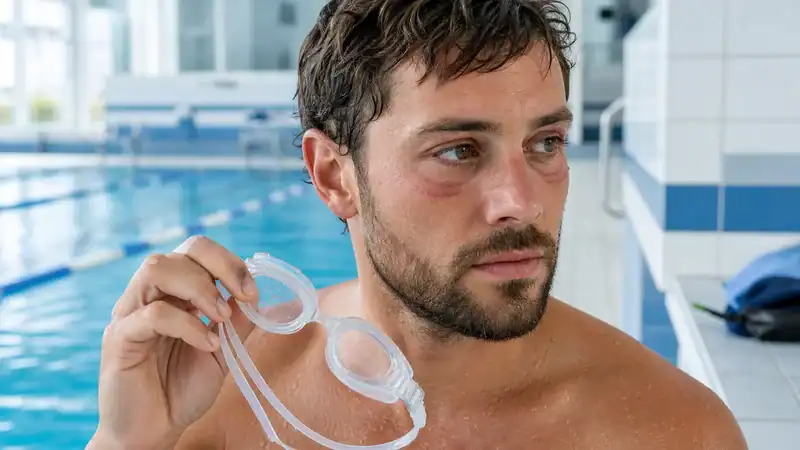
That’s localized edema: the same mechanism that causes swelling anywhere sustained pressure is applied to soft tissue. The result is the ring of puffiness and indentation you see in the mirror after a swim.
The fix is almost never “loosen the strap.” The fix is fit.
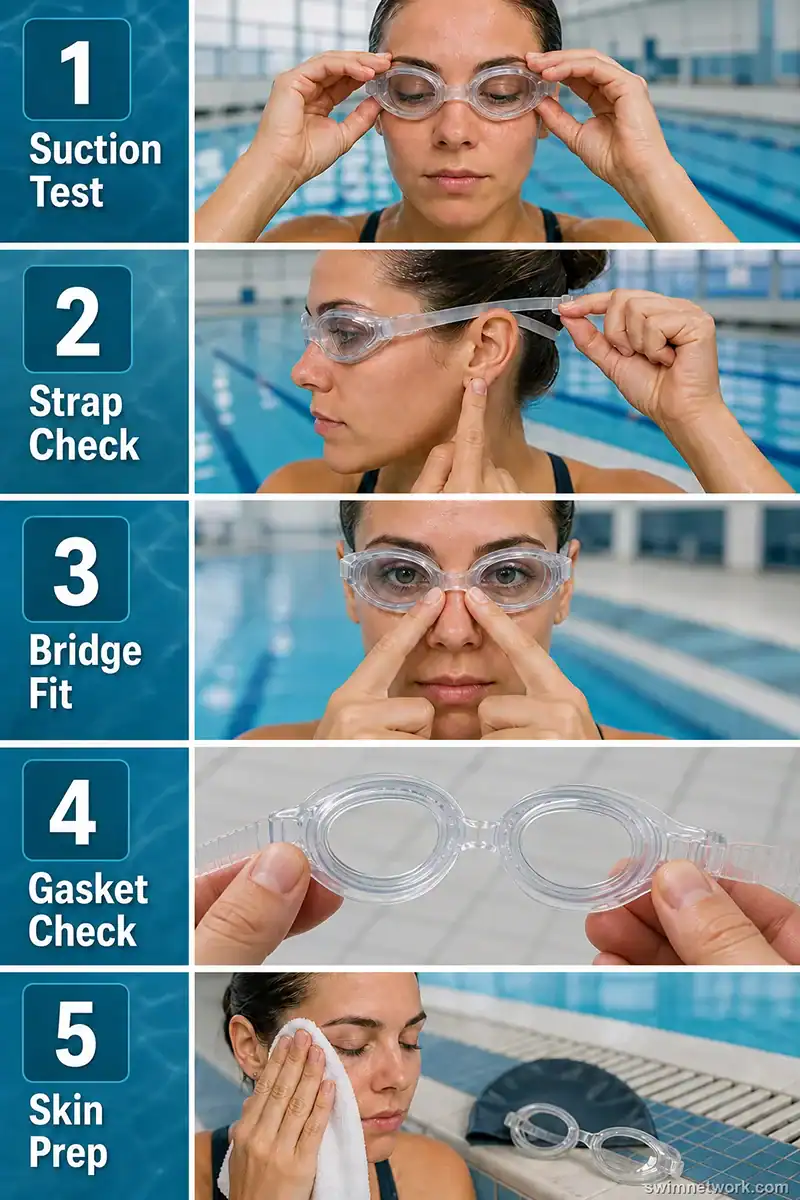
Step 1: The Dry Suction Test – Run It Before You Tighten Anything
Every swimmer should be running this test before every session. Almost no one does.
Here’s how it works:
- Remove the strap from the equation entirely – let it hang loose behind the goggles.
- Press the goggle gently against your eye socket. Don’t jam it – gentle, centered pressure.
- Release. Let go completely.
- Watch what happens. Good-fitting goggles will hold their own seal for three to five seconds. Bad-fitting goggles – wrong gasket shape for your face – drop immediately.
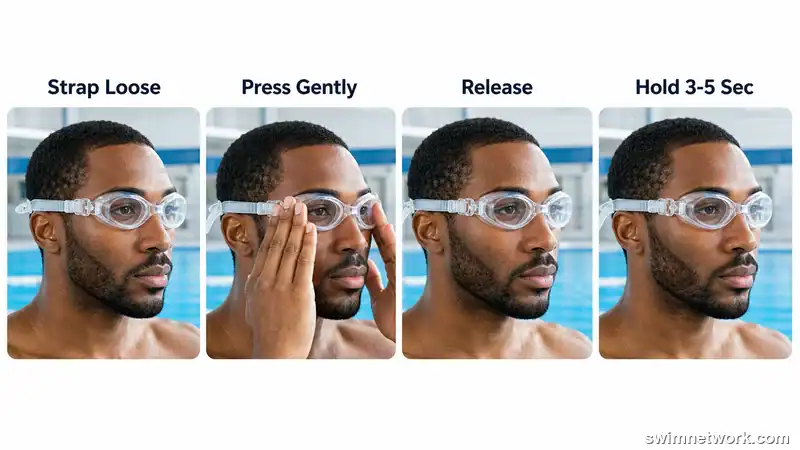
If your goggles pass the test, you have a fit that works. If they fall off the moment you let go, no amount of strap tension is going to fix it.
💡 Coach’s Tip
“If your goggles can’t pass the dry suction test, no amount of strap tension will stop the marks – or the leaking. The strap is compensating for the wrong shape. Stop the compensation; fix the shape.”
For a deeper look at finding the right goggle for your face shape, see our complete guide to swim goggle fit and sizing.
What to Do When the Test Fails
A failed dry suction test gives you three paths forward – and none of them involve tightening anything.
(A) Try a different nose bridge width. The nose bridge controls how the frame sits relative to your eye sockets. The wrong width pulls the gasket off-center (more on this in Step 3).
(B) Switch to a softer or different gasket profile. Some gasket shapes – flatter, deeper, or foam-edged – suit certain face shapes better than others.
(C) Accept that this goggle isn’t shaped for your face. This is a hard one. But a goggle that fails the suction test is going to leave marks and leak no matter what you do with the strap.
Step 2: Your Strap Is Probably Two Notches Too Tight
Here’s the mental model most swimmers have: tighter strap = more secure goggles = fewer marks. It’s exactly backwards.
The strap keeps the gasket from shifting during a flip turn or a dive. It is not designed to create the seal. When you overtighten the strap chasing a better seal, you’re compressing the gasket deeper into soft periorbital tissue – and that’s where the marks come from.
The practical tension target is simple: the strap should be snug enough that one finger slides underneath it at the back of your head. That’s it. If it takes effort to get a finger under there, it’s too tight.
Fix your goggle seal without overtightening the strap – that article goes deep on the mechanics if you’re also dealing with leaking.
One more trick worth knowing: the double cap method. Put on your first cap, then your goggles, then a second cap over the strap. The second cap locks everything in place during competitive starts or dives without adding any strap tension at all. I’ve had age-group swimmers use this for years. If you’re competing seriously, it’s also worth understanding what makes competitive racing goggles different from training pairs – the low-profile gasket and narrower frame are why they hold under a race start where a training pair might not.
📹 Video Quick Recap:
- The gasket creates the seal – the strap only holds it in place; most swimmers have this backwards
- One-finger rule: strap tension should allow a finger to slide under the strap at the back of the head
- Double cap method: cap → goggles → second cap locks goggles without additional pressure – ideal for dives and competitive starts
Step 3: The Nose Bridge That Actually Fits Your Face
Ever notice that one side of your face marks worse than the other? Nine times out of ten, that’s a nose bridge problem.
When the nose bridge is the wrong width – too wide or too narrow – the goggle frame can’t sit level across your face. That off-balance frame pushes one side of the gasket harder into your skin than the other.
The gasket distorts. You get concentrated pressure on one side instead of even pressure all around. The marks are deeper under one eye, and the dry suction test might even show the goggle tilting slightly in one direction.
Signs of a nose bridge mismatch:
- Marks are consistently worse under one eye
- Goggles tilt or feel like they’re pulling to one side
- The frame doesn’t sit level without the strap
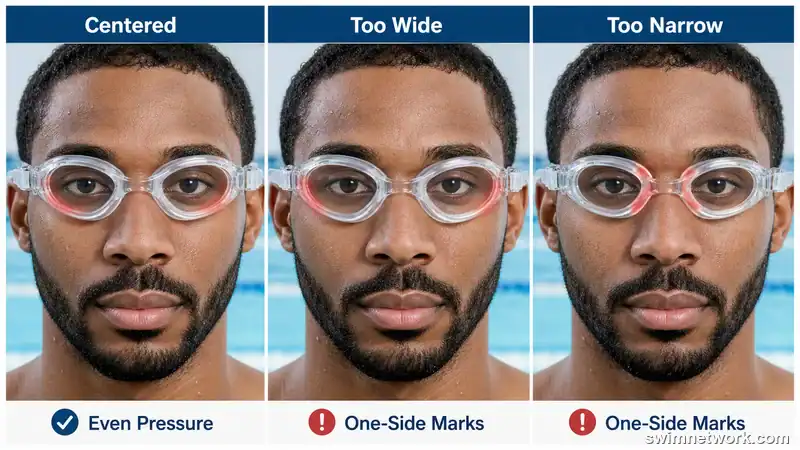
The fix is to try every bridge size the goggle ships with. Most pairs come with two or three options, and they make a significant difference. Sit the goggle on your face without the strap – just let it rest there. It should sit level, with the lenses roughly centered over your pupils.
💡 Coach’s Tip
“A $2 nose bridge replacement can fix a goggle that a $30 purchase can’t. Most swimmers throw away a working goggle because the bridge was never right. Try them all before you bin it.”
Step 4: Your Gasket Has an Expiry Date – Check It Like This
Fresh silicone is soft and conforming. It molds to your face and creates an even seal without much pressure. Old silicone stiffens, loses its ability to conform to facial contours, and stops sealing well – so swimmers compensate by tightening the strap.
USMS research documents this clearly: goggles older than roughly six months tend to lose gasket flexibility. The gasket hardens, requires more strap tension to create a working seal, and as a result, drives deeper into your periorbital tissue.
The marks get progressively worse over the course of a season… and most swimmers blame themselves, not the gasket.
The 30-second field check:
Press your thumb firmly across the gasket edge and then release.
- Fresh gasket: Pliable, springy – bounces back immediately.
- Degraded gasket: Stiff, holds a crease, doesn’t bounce back.
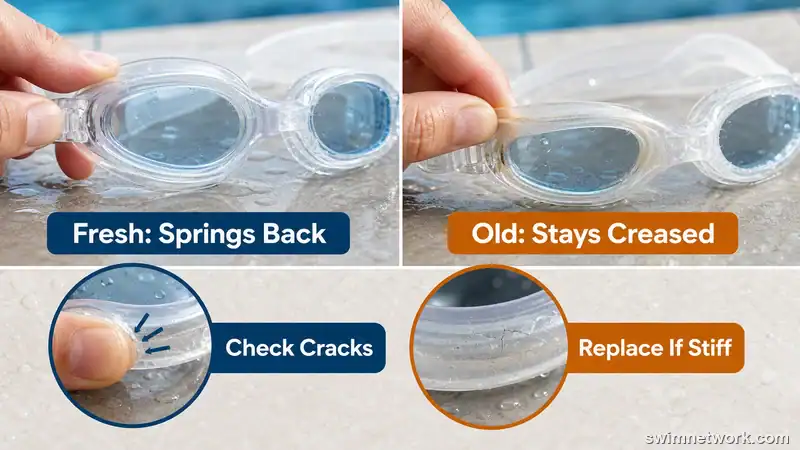
Also look for discoloration, micro-cracking, or any areas that have permanently flattened where the gasket used to make contact with your face. Any of those signs means the gasket is past its prime.
If it fails the check, tighter straps won’t fix it. The seal is gone. Learn more about how long swim goggles actually last before the gasket hardens.
💡 Coach’s Tip
“Most swimmers replace their goggles because the lens scratches. The gasket usually goes bad first. If you’re getting worse marks mid-season than at the start, run the thumb test. You might just need new goggles.”
Step 5: A Little Skin Prep Goes Further Than You’d Expect
This one is optional – it’s not the primary fix. But for swimmers who have sorted fit, strap tension, nose bridge, and gasket condition, a small amount of pre-swim skin prep may help.
The theory: dry periorbital skin compresses more sharply under gasket pressure. A thin layer of non-oil-based, water-safe balm or moisturizer applied to the eye socket area before swimming may reduce how deeply the gasket compresses into dry skin.
Critical qualifier: non-oil-based only. Oil-based products degrade silicone gaskets over time and can cloud polycarbonate lenses. The same oil-free requirement applies near the gasket zone for swimmers with eyelash extensions – see what that means for swimmers with eyelash extensions before your pre-swim skin prep. Jojoba-free, petroleum-free options are safer choices.
- Apply a thin layer to the eye socket area before getting in the water
- Non-oil-based only – check the label
- Reapply before long sessions or open water swims where goggle-on time is extended
Sorted fit is worth 90% of the improvement. This is the last 10%.
Already Got the Marks? Three Ways to Clear Them Faster
For most healthy swimmers, goggle marks and puffiness resolve on their own within 20–45 minutes after goggle removal. That’s the soft tissue rebounding as the gasket pressure is released – the same principle that Cleveland Clinic describes for localized edema resolving when the pressure source is removed.
If you want to speed it up, here are three options:
- Cool cloth or gel eye mask – 5–10 minutes. The gentle cold helps reduce the temporary puffiness. Do NOT place ice directly on the skin around your eyes. The periorbital area is too delicate – ice contact can damage that thin skin. A gel eye mask kept in the fridge is the better option.
- Gentle upward facial massage. Light upward strokes around the orbital area help shift stagnant fluid. Nothing aggressive – fingertips only.
- Niacinamide (Vitamin B3). This skincare ingredient, found in many serums, can help reduce redness and support skin recovery. It’s cosmetic, not medical – and it won’t replace proper fit – but it’s a reasonable addition to your post-swim routine if the marks bother you aesthetically.
If marks haven’t resolved within a few hours, or if they’re accompanied by eye pain or any change in vision, see a doctor. That’s beyond normal goggle-mark territory.
If You Have Glaucoma, Read This Before Your Next Swim
This section is specifically for swimmers who have been diagnosed with glaucoma or elevated intraocular pressure.
A 2007 peer-reviewed study published in the Yonsei Medical Journal measured intraocular pressure (IOP) in healthy volunteers before, during, and after wearing standard swim goggles.
The result: IOP rose by an average of 2.32 mmHg immediately upon wearing goggles and returned to baseline upon removal. For most healthy swimmers, this temporary elevation is not clinically significant.
For people with advanced glaucoma, it’s a different picture. Any sustained IOP elevation – even a modest one – can be detrimental to the optic nerve.
The same study explicitly recommended that advanced glaucoma patients who swim regularly “be carefully monitored” or use specially-designed low-profile, low-pressure goggle designs.
Three takeaways if you have glaucoma:
- Talk to your ophthalmologist before using standard goggles. This isn’t a conversation to skip. Your doctor needs to know how much you swim and what equipment you use.
- Low-profile and low-gasket-pressure goggle designs exist specifically for this concern. They reduce the amount of periorbital compression during wear.
- Looser strap tension reduces periorbital pressure. Per Step 2 above: one-finger rule. No overtightening. This applies doubly for at-risk eyes.
For broader guidance on exercise and glaucoma, the Glaucoma Research Foundation’s guidance on sports and exercise is the right starting point.
This section is informational and not a substitute for advice from your ophthalmologist.
Four Goggle Mark Questions – Straight Answers, No Filler
How long do goggle eyes usually last?
For most swimmers, marks and puffiness fade within 20–45 minutes after goggle removal – the soft tissue rebounds once pressure is removed. Skin that is drier, older, or more sensitive may take closer to an hour.
If marks persist beyond a few hours or are accompanied by pain, that warrants a doctor visit. Not a googling session – a doctor.
Can I use an ice pack or cold water on goggle marks?
Cool water or a cold damp cloth works well – apply for 5–10 minutes. Do not place ice directly on the skin around the eyes. The periorbital area is thin and delicate, and direct ice contact can cause skin damage.
A gel eye mask kept in the fridge is a significantly better option and something worth keeping in your swim bag.
My goggles still leave marks even when I loosen the strap – why?
Because loose strap alone doesn’t fix a fit problem. If the gasket shape is wrong for your face, or the gasket is degraded, the marks will persist regardless of tension. Run the dry suction test (Step 1).
If the goggles drop immediately even with a loose strap, the fit is wrong – not the tension. That’s the diagnosis. Step 3 and Step 4 give you the fix.
Are goggle marks dangerous for your eyes?
For most swimmers, no – they are cosmetic and temporary. That said, standard swim goggles do measurably raise intraocular pressure while worn, as documented in Ma et al. (2007).
For people with advanced glaucoma, even modest sustained IOP elevation can be harmful. If you have any diagnosed eye condition, consult your ophthalmologist before continuing to swim with standard goggles. Contact lens wearers should also be aware of the contact lens risk that goggles don’t fully solve.
Goggle-Eye-Free Starts With One Test
Most of these marks come from one bad habit – overtightening – covering for one fixable problem: wrong fit.
The strap isn’t the villain. It never was. It’s just doing too much because the gasket isn’t doing its job. Sometimes the gasket is the wrong shape for your face. Sometimes it’s degraded.
Sometimes the nose bridge is a millimeter too wide and the whole frame has been sitting crooked since the day you bought it.
Run the dry suction test before your next session. Five seconds. If the goggles hold, you’re working with a fit that can actually be dialed in.
If they don’t… well, now you know why the marks never went away. That’s not a strap problem. That’s a goggle problem.
And that’s a very fixable problem. If you’re ready to evaluate a different pair, our guide to choosing swim goggles that seal without pressure marks covers fit testing, gasket profiles, nose bridge sizing, and when to replace a degraded pair.
Disclosure: This article features AI-assisted imagery to help provide a more intuitive and visual reading experience.

 Your Goggles Keep Ripping Your Hair? Why Bungee Straps Actually Work
Leave a Reply