
I’ve coached swimmers at every level – age groupers, club kids, adult masters – and one question comes up more than you’d expect: “Coach, I wear contacts. Can I just wear them under my goggles?”
The assumption behind the question is reasonable. Goggles create a seal around your eyes. If the seal holds, your contacts stay dry. What’s the risk?
A bigger one than most people realize.
The FDA, the CDC, and the American Optometric Association have all issued clear guidance on this – wearing contact lenses under swim goggles is not a safe practice, even with goggles that fit well.
Whether you’re training in a chlorinated lap pool or racing an open-water triathlon, the question of whether you can wear contact lenses under swim goggles has a direct answer from the medical community, and it’s worth understanding why.
Let’s start with what actually happens inside your goggle.
🏊 Key Takeaways
- Short answer: No, not safely. Contacts under goggles is elevated risk – not an acceptable workaround.
- Soft contact lenses are made of water-absorbing hydrogel material. They absorb pool water – and whatever pathogens are dissolved in it.
- No goggle creates a completely watertight seal. Any water that enters contacts your lenses directly.
- If you have no alternative on a given day, daily disposables discarded immediately after swimming reduce – but do not eliminate – the risk.
- The only genuinely safe option is prescription swim goggles. They correct your vision without any lens touching your eye.
⚠️ Safety Disclaimer & Target Audience
Best for: Swimmers, triathletes, and recreational swimmers who wear prescription contact lenses.
Medical note: This article is for informational purposes only. Consult your eye care provider before making any decisions about contact lens use during swimming.
What Actually Happens to a Soft Lens in Pool Water
Most swimmers assume chlorinated pool water is essentially clean. The pool smells like chlorine. Bacteria die in chlorine. So if you wear contacts under goggles and a little water gets in… it’s fine. Right?
Not exactly. And the reason comes down to the material your contact lenses are made from.
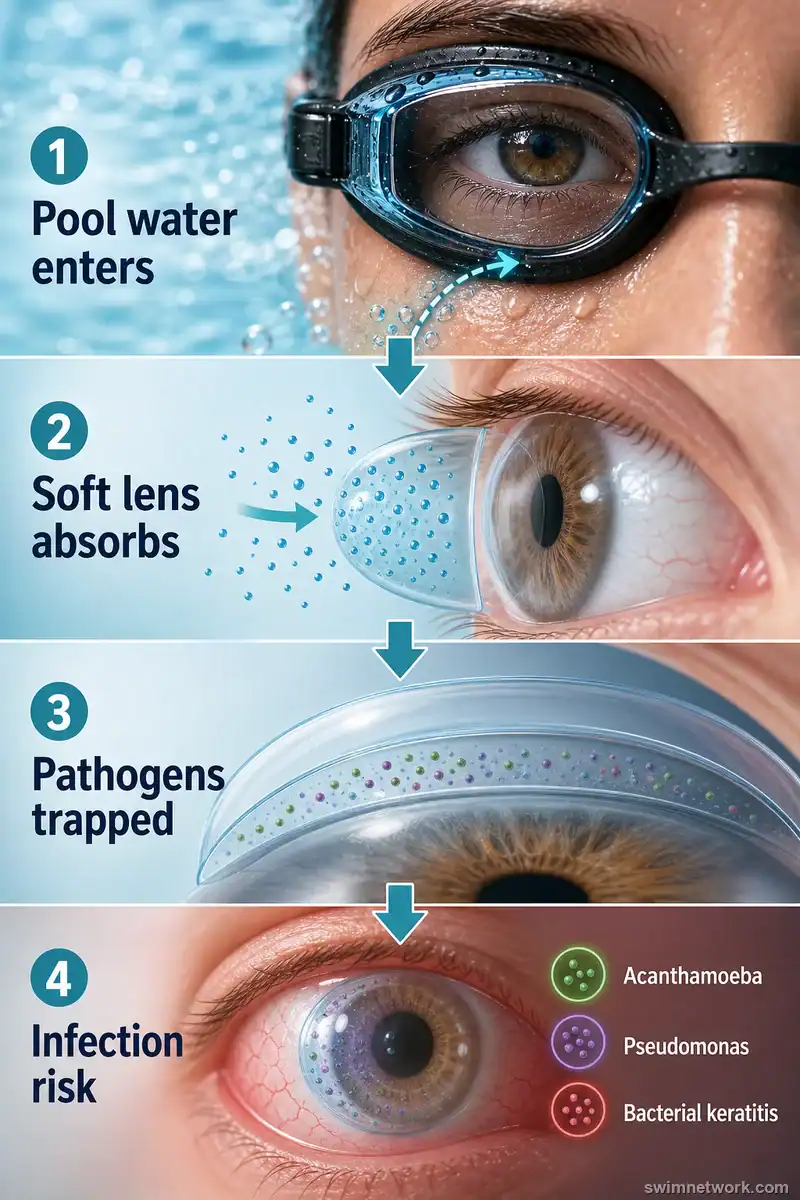
Soft contact lenses – including silicone hydrogel lenses – are designed to be hydrophilic. That means they love water. They absorb it.
A soft lens sitting on your cornea is constantly exchanging oxygen and moisture with your tear film, and it does the same thing with any other fluid it contacts.
When pool water reaches your contact lens, the lens absorbs it. Along with everything dissolved in that water – according to the CDC, contacts should be removed before any water exposure precisely because of this absorption mechanism.
Pool water isn’t sterile. Chlorine reduces microbial load – it doesn’t eliminate it entirely.
The Cleveland Clinic explains it directly: soft lenses are porous and absorb bacteria and chemicals from water. Their guidance follows what they call the “Three Ss” rule – never Sleep, Shower, or Swim in contact lenses.
In other words… your contact lens doesn’t just sit passively in the water. It becomes a sponge for whatever’s in it.
Once the lens has absorbed contaminated water, the space between the lens and your cornea becomes the problem. That space is warm, moist, and enclosed – ideal conditions for any microorganism that ends up there.
The lens traps them against your cornea, and your cornea can’t flush them away the way it normally would with natural blinking and tear production.
Your Goggles Won’t Save You – The Physics Explains Exactly Why
So goggles, then. That’s the fix. Wear goggles with a tight seal and the water stays out. Problem solved.
I’ve heard this reasoning many times. And I understand it – goggles do reduce exposure. But they don’t eliminate it.
Here’s the key thing most swimmers don’t know: no swim goggle creates a hermetic (airtight, watertight) seal. Face shapes vary. Nose bridge gaps allow pressure equalization. Strap tension changes the gasket geometry slightly. And over time, silicone gaskets degrade and harden.
Even well-fitted goggles can leak – that’s not a defect, it’s physics.
Any gap – even a tiny one – allows pool water in. And that water reaches your contacts.
There’s also something worth acknowledging about goggle pressure on the eye area. When goggles are worn tight enough to feel “secure,” the gasket presses against the periorbital tissue surrounding the eye – not against the eyeball itself.
The goggle creates an air pocket over the eye, but that pocket isn’t fully sealed from pool water under real swimming conditions, especially during dives, flip turns, or any moment the seal is disrupted.
📹 Video Quick Recap:
- Soft lenses act as sponges for water-borne pathogens – the absorption happens even with brief exposure.
- Pseudomonas aeruginosa and Acanthamoeba are the primary infection threats; both can cause serious corneal damage.
- Goggles are not a foolproof barrier – Dr. Wong confirms that no goggle eliminates the risk for contact lens wearers.
The Infection That Can Blind You – And Why Chlorine Won’t Stop It
This is the part that changes the conversation for most swimmers I’ve coached. It’s not just a theoretical risk of “some bacteria.” There are specific, named organisms that contact lens wearers are especially vulnerable to – and the most dangerous one is resistant to chlorine.
Acanthamoeba is a naturally occurring amoeba found in freshwater, saltwater, soil… and in treated pool water. It’s microscopic and it’s everywhere. In healthy people without contact lenses, it rarely causes harm. But in contact lens wearers, it can cause Acanthamoeba keratitis – a serious infection of the cornea.
Here’s the mechanism that makes it especially dangerous: when environmental conditions become hostile – including chlorination – Acanthamoeba forms cysts. These cysts are resistant to the concentrations of chlorine used in public pools.
Standard pool disinfection is designed to control a broad range of pathogens, but cyst-forming organisms like Acanthamoeba can survive it.
When a soft contact lens absorbs pool water that contains Acanthamoeba, the space between the lens and the cornea becomes a sheltered environment – warm, moist, enclosed.
The CDC lists Acanthamoeba keratitis as a specific risk for contact lens wearers in aquatic environments.
The Cleveland Clinic confirms this, noting that pool water, lakes, and hot tubs are all documented exposure routes, alongside bacterial pathogens including Pseudomonas aeruginosa and Staphylococcus aureus – both of which can cause corneal ulcers.
Acanthamoeba keratitis is rare. I want to be clear about that – the vast majority of swimmers who’ve accidentally worn contacts in the pool don’t develop it.
But when it does occur, it is notoriously difficult to treat and can cause permanent vision loss. It is not like a standard eye infection that clears up with antibiotic drops.
Ocean and Lake Water? The Risk Goes Up Significantly
If you’re a triathlete or open-water swimmer reading this – pay attention here, because this applies to you directly.
Treated pool water has at least some microbial control. Oceans, lakes, and rivers have none. There’s no chlorine, no pH regulation, no filtration. Acanthamoeba concentrations in natural bodies of water are substantially higher than in treated pools.
Bacterial load is higher. Fungi are present. There are organisms in open water that simply don’t exist in a managed pool environment.
The AOA recommends against any water exposure to contact lenses – and that recommendation includes open water. If pool water is a risk, open water is a substantially larger one.
If you’re racing a triathlon and you rely on contacts for vision, this is exactly the situation prescription swim goggles are designed for. More on that below – but first, let’s talk about what you can do if you genuinely don’t have them yet.
No Prescription Goggles Yet? The Lowest-Risk Move for Contact Wearers
Let me be direct: if you have prescription swim goggles, use them. What follows is a harm-reduction protocol – not a workaround that makes contacts in the pool acceptable. It’s the lowest-risk approach for someone with a high prescription who doesn’t yet have an alternative on a given training day.
Emphasis on lowest-risk. Not risk-free.
The FDA warns explicitly that water exposure to contact lenses carries elevated infection risk, regardless of the precautions taken.
If you find yourself in this position, here’s what to do:
- Use daily disposable lenses only. Not monthly, not bi-weekly. Daily disposables are discarded after a single use – you won’t be carrying contamination forward into your case or reusing a lens that absorbed pool water.
- Wear the best-fitting goggles you own. Before entering the water, press the goggle lenses gently against your eye sockets without the strap – the suction should hold for 3–5 seconds. If it doesn’t, try a different pair.
- Do not touch or adjust your goggles mid-swim. Every adjustment breaks the seal temporarily.
- Exit the water immediately if you feel water inside your goggles. Don’t finish the set. Get out, remove the goggle, assess.
- Remove and discard both lenses immediately after your session. Do not rinse. Do not put them back in their case. Do not reuse them.
- Rinse your eyes with sterile saline or preservative-free artificial tears. Do not use tap water.
- Monitor for symptoms. Redness, pain, unusual sensitivity to light, or blurred vision in the 24–48 hours following swimming warrant a call to your eye care provider.
The discard step is non-negotiable. A daily disposable lens that has been in pool water has done its job. It goes in the bin, not back in your eye.
This protocol reduces risk – it does not eliminate it. The only zero-risk option is prescription swim goggles.
Prescription Swim Goggles Are the Only Real Answer
Here’s the thing about prescription swim goggles that I tell every swimmer who hesitates: they correct your vision without anything touching your eye. There’s no lens sitting on your cornea.
There’s no hydrogel absorbing pool water. The optical correction is built into the goggle lens itself – the water stays outside, and your eyes are just… eyes.
The AOA identifies prescription goggles as the safest alternative for contact lens wearers who need vision correction in the water. It’s not a controversial position – it’s the obvious one when you understand the mechanism we’ve been discussing.
The practical objections I usually hear are cost and convenience.
On cost: prescription swim goggles are substantially less expensive than treating a corneal infection – and that’s before accounting for the vision risk.
On convenience: if you’re swimming regularly, prescription goggles are less inconvenient than you think. They go in your bag. You put them on. Done.
For high prescriptions or astigmatism, there are more options to choose from now than there were even five years ago. Our choosing the right swim goggles guide covers fit fundamentals, and the prescription goggles guide walks through the diopter math for anyone with a complex Rx.
💡 Coach’s Perspective
I’ve watched young competitive swimmers squint through training sets wearing contacts under their goggles – I’ve been that coach who didn’t push back hard enough on it. The conversation changes completely when you explain what’s actually happening at the lens-cornea interface. Most of them had never heard of Acanthamoeba.
Most of them didn’t know their goggles weren’t fully watertight. Once they understood the mechanism, the question stopped being “can I?” and became “where do I get prescription goggles?”
📹 Video Quick Recap:
- Real clinical cases of vision loss from water exposure while wearing contacts – including from showers, not just swimming.
- Parasites thrive in the space between the contact lens and the cornea; the lens creates ideal conditions for them.
- If water exposure is unavoidable, tight-fitting goggles are mandatory – but the lenses must still be discarded immediately afterward.
The Contact Lens Questions I Hear Every Single Season
Can swim goggles protect your eyes if you wear contacts?
No, not fully. Goggles reduce the amount of water that reaches your contact lenses, but they do not create a watertight seal. Face shape variation, nose bridge gaps, strap tension changes, and gasket degradation all allow micro-amounts of pool water to enter.
When water contacts a soft lens, the lens absorbs it – along with any organisms or chemicals dissolved in it. The FDA’s position is that any water exposure to contact lenses carries elevated infection risk, regardless of whether goggles are worn.
What happens if water gets under your goggles while wearing contacts?
Remove and discard your lenses as soon as possible. The lens has already absorbed contaminated water – continuing to wear it extends pathogen contact with your cornea, which is the opposite of what you want. Rinse your eyes with sterile saline if available.
If you experience redness, pain, increased light sensitivity, or unusual discharge in the following 24–48 hours, contact your eye care provider promptly. Do not wait to see if it clears on its own.
Are daily disposable contacts safer for swimming than monthly lenses?
Safer in one specific way – and still not recommended. Daily disposables are discarded immediately after use, so any contamination from the swim session doesn’t carry forward into a lens case or get reused.
Monthly lenses worn in pool water and then stored carry contamination into the case, the solution, and the next wear cycle.
That said, “safer” doesn’t mean “safe.” The absorption risk during the swim itself applies to all soft lens types. The AOA and FDA both recommend removing all contacts before water exposure, regardless of lens type.
Can you wear contacts in the ocean or lake?
No. Natural bodies of water have no chlorine treatment and no filtration. Acanthamoeba and bacterial pathogens are present at substantially higher concentrations than in treated pools. The risk of keratitis – including the Acanthamoeba variant – is significantly elevated in open water.
For triathletes and open-water swimmers who need vision correction, prescription swim masks or prescription open-water goggles are the appropriate solution.
What is Acanthamoeba keratitis and how do swimmers get it?
Acanthamoeba is a naturally occurring single-celled organism found in freshwater, soil, and occasionally in treated pool water. Contact lens wearers are the primary risk group because the space between the lens and the cornea creates ideal conditions for the organism to establish and multiply.
Acanthamoeba keratitis causes corneal inflammation, pain, light sensitivity, and – in serious cases – vision loss. The CDC identifies it as a specific risk for contact lens wearers in aquatic environments. Early diagnosis and treatment are critical.
If you suspect you’ve had contact lens exposure to natural or pool water and develop eye symptoms, see your eye care provider – don’t wait.
You Can See Clearly and Swim Safely – But Not With Contacts
Your vision correction needs are real. Swimming with uncorrected vision isn’t a workable option for everyone – I know that.
But the solution to that problem is prescription swim goggles, not contacts under a pair of standard goggles. The technology exists, it’s widely available, and it doesn’t require you to choose between seeing clearly and protecting your eyes.
Whether you’ll make the switch this season or next… that’s up to you. But at least now you know what you’re actually choosing between.
When you’re ready to evaluate which pair to buy, our guide on how to choose swim goggles that fit and stay sealed covers the full selection process — fit testing, lens types, strap options, and long-term care.
Disclosure: This article features AI-assisted imagery to help provide a more intuitive and visual reading experience.

 Swim Cap Over or Under Your Goggle Straps? Coaches and Competitive Swimmers Do It Differently
Leave a Reply