
I’ve watched swimmers finish a race half-blind because their goggles were floating behind them – cap ridden forward, strap slipped free on the dive. Not bad luck. Bad cap setup.
Whether to put your swim cap over or under goggle straps depends entirely on what you’re doing.
Training, racing, and open water each have a different right answer – and this guide walks through all three, including the one gasket mistake I see constantly that causes goggles to leak for no obvious reason.
🏊 Quick Summary – Key Takeaways
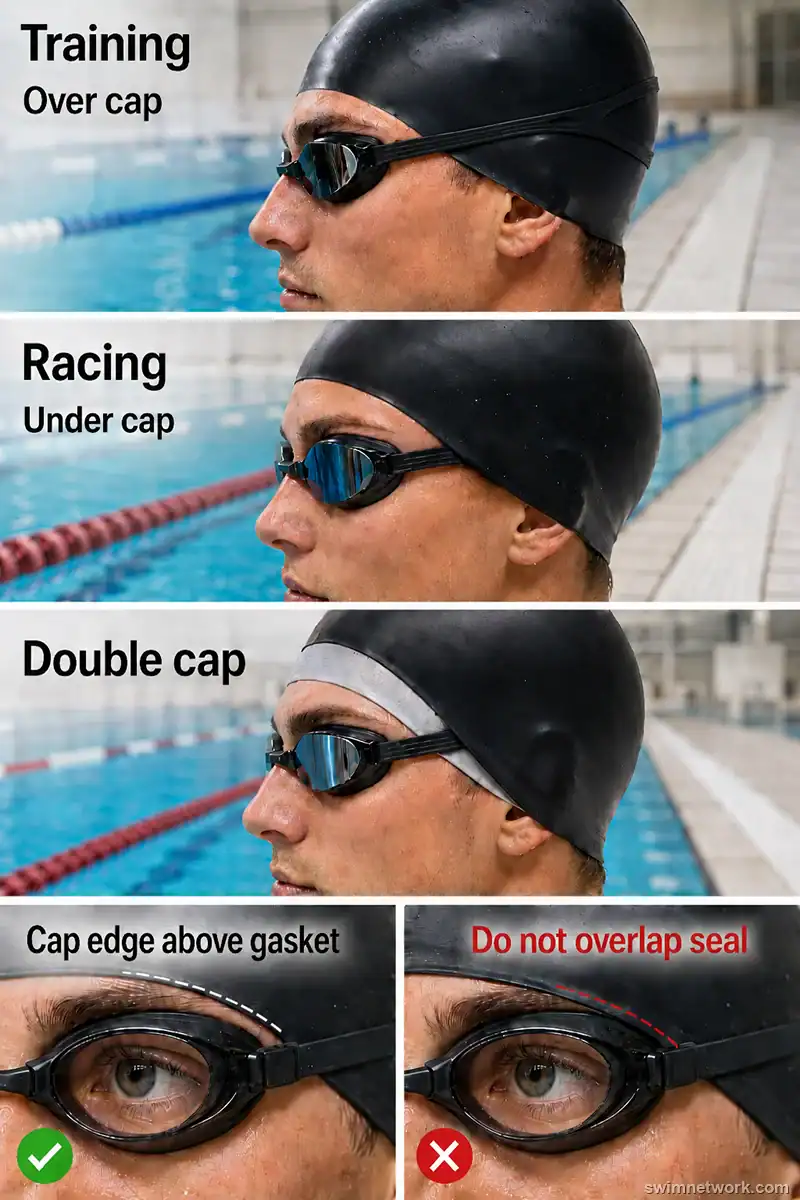
- Training: Put goggles on over the cap – easier to adjust mid-session without removing anything.
- Racing (pool): Goggles go under the cap, or use the double-cap method – strap security on starts and turns is non-negotiable.
- Open water / triathlon: Double cap, every time – contact starts can strip over-cap goggles off your head.
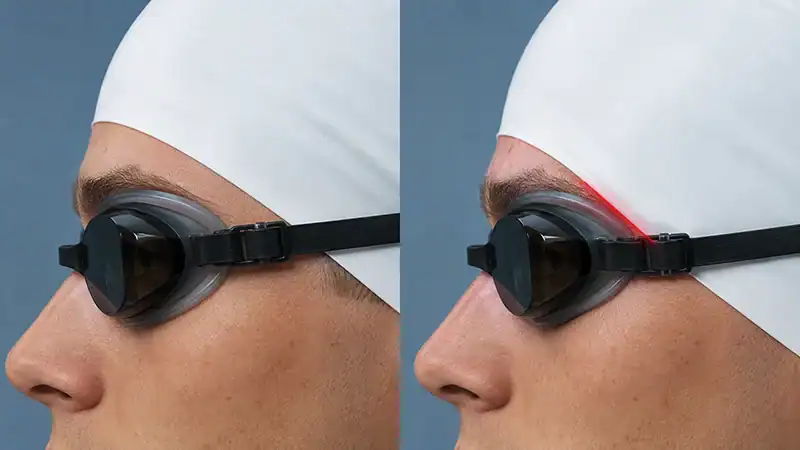
- The one rule that applies everywhere: The cap edge must never overlap the goggle gasket – it breaks the suction seal and causes unexplained leaks.
⚠️ Safety Disclaimer & Target Audience
Best for: All swim levels – beginner recreational swimmers to competitive athletes.
Skip if: No specific exclusions for this technique guidance. If you have a latex allergy, check the cap material section before deciding on a double-cap setup.
Coach’s reminder: Cap placement is a fit issue, not a fitness issue – get it right before you get in the water.
It Depends. And the Reason Is Simple.
Here’s the version you can use right now:
| Context | Method | Why |
|---|---|---|
| Pool training | Goggles over cap | Easy to adjust mid-session |
| Pool racing | Goggles under cap or double cap | Strap security on starts and turns |
| Open water / triathlon | Double cap | Protection against contact start chaos |
That table is a starting point – not a rule carved in stone. If you are also working through which goggles to pair with this setup, our guide to choosing swim goggles with the right fit and gasket profile covers seal testing, lens options, strap types, and replacement signals.
There’s no single “correct” answer for every swimmer in every situation. What the USMS community thread on this topic makes clear is that experienced Masters swimmers overwhelmingly default to over-cap for training and under-cap or double-cap for competition. The reasons why are practical, not arbitrary.
The next sections walk through each method – what it does well, where it fails, and how to actually execute it correctly.
Cap Over Goggles Works in Training – Not on Race Day
For most training swimmers, this is the default – and it works fine.
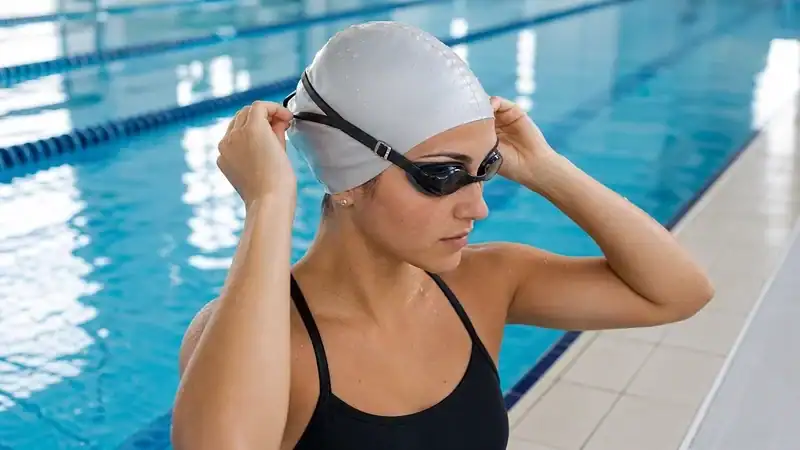
Goggles go on first, then the cap goes on over them. Simple. And there are three real reasons this is the training-session standard.
First, you can adjust your goggle strap without taking the cap off. Mid-set, your seal loosens? Reach back, tighten the strap, done. Try doing that with straps locked under a cap.
Second, the straps don’t press into your scalp through a tight cap. When straps run under the cap, they create pressure lines that some swimmers find uncomfortable during long sessions.
Third, for swimmers with longer hair, the over-cap method is significantly easier to manage. Tucking everything under and then seating the cap takes time – and over-cap skips that step entirely.
The real drawbacks? On slick silicone caps, goggle straps can ride up during dives.
Not every time, but often enough that competitive swimmers ditch this method for anything race-like.
And if you’re wearing the strap on top of the cap long-term, it does create a slightly higher pressure point where the strap sits across your face – which can contribute to goggle eyes and those classic post-swim pressure rings around your eye sockets.
Over-cap is perfectly valid for training. It’s just not what you want when a dive or flip turn is involved.
Cap Under Goggles Is the Racing Standard. The Seal Tells You Why.
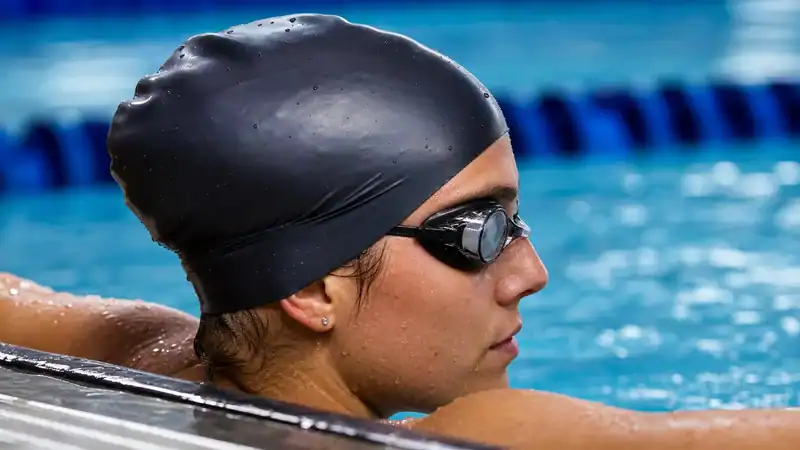
Placing goggle straps under the cap is the competitive standard for pool racing. When you do this, the cap itself becomes a second layer of security – the straps physically cannot shift on a dive or a flip turn because the cap is holding them in place.
There’s also a drag argument. A smooth cap surface reduces frontal drag, and that surface needs to be uninterrupted.
Straps sitting on top of the cap break the profile. According to SwimSwam, a dome racing cap produces 10.5% less frontal drag with a dome cap compared to a standard silicone cap – and that advantage depends entirely on the smooth outer surface staying smooth.
Strap type matters here too. Thinner, more flexible straps sit flatter under a cap. If you’re using heavy clip-style straps, they create a bulge under the cap that can affect the seal and the profile.
Bungee straps vs. silicone straps is a topic worth understanding before you go under-cap – bungee straps sit much flatter and are generally preferred for this setup.
The one real drawback: you cannot adjust mid-swim. The straps are locked in. So this method requires you to nail the fit exactly before you get in.
💡 Coach’s Tip
Do a dry suction test before sliding the strap under the cap – press the goggles against your eye area without using the strap at all. If the seal holds for 3 seconds, your fit is right. If it doesn’t, adjust the nose bridge or swap to a different goggle model. You cannot fix a bad seal once everything is seated.
Double Capping Is What Competitive Swimmers Use at Starts
Double-capping is the method most competitive swimmers use at meets – and it’s simpler than it looks once you understand the order.
Here’s the sequence:
- Put the first (inner) cap on – ideally a latex cap, or a thin silicone cap. This goes directly on your head.
- Position your goggles on the outside of that first cap, sealing them normally. Run the suction test here, before anything else goes on.
- Pull the second (outer) cap – usually a silicone racing cap – over the goggles, pressing the straps flat against the inner cap.
- Pull the outer cap’s back edge down gently to cover the strap loop cleanly, creating a smooth profile across the back of your head.
Two mistakes I see constantly at meets:
Mistake one: Pulling the outer cap down too far so its edge overlaps the goggle gasket. This breaks the seal – I’ll cover this in full detail in the next section because it’s the most common and most invisible cause of goggle leaks.
Mistake two: Skipping the suction test between steps 2 and 3. Once the outer cap is on, you’re locked in. If the fit wasn’t right before the cap went over, you cannot adjust it without taking everything off and starting again.
- For racing, goggle straps go under the cap – not over – for maximum security on starts and turns.
- Double-cap order is fixed: latex (or thin silicone) inner cap → goggles seated and sealed → silicone racing cap over straps.
- Pull the outer cap’s back edge slightly downward over the goggle frame to create a seamless hydrodynamic profile.
- Hair management matters – braid or tuck low before capping to prevent cap/strap bulge.
- Over-cap is fine for training; under-cap and double-cap are for competition.
💡 Coach’s Tip
Use a latex inner cap if you can. It grips your scalp better than silicone, which means the inner cap stays put while you wrestle the outer cap over the goggles. A silicone inner cap tends to rotate during the outer cap installation – frustrating and messy.
The One Mistake That Breaks Your Goggle Seal – and Most Swimmers Make It
Here’s the mistake I see most often, including in competitive swimmers who’ve been doing this for years.
When you pull the swim cap down – especially the outer cap in double-capping – the cap’s edge can land directly on top of the goggle gasket. Right on the silicone seal.
What happens next is invisible and maddening: the cap applies outward pressure on the gasket rim.
That pressure pushes the gasket away from your face at the overlap point, breaking the suction. The result? Water seeping into your goggles mid-race, for what feels like no obvious reason.
You tightened the strap. You did the suction test. And your goggles are still leaking.
The fix is simple, once you know what to look for.
After seating your goggles and pulling the cap down, check that the cap’s lower edge sits above the gasket line – on the forehead side of the seal, not on top of it. The cap rim should never cross over the gasket. Run a finger gently around the full perimeter of the gasket to confirm it’s fully exposed below the cap edge.
This check takes five seconds. It becomes habit quickly. And it eliminates an entire category of unexplained leaks.
If you’re dealing with leaks and you’re not sure where they’re coming from, this might be it – and if you want the full troubleshooting breakdown, why your goggles might start leaking covers every cause in detail.
Does Cap Material Change Which Method Works Best?
Short answer: yes, and it’s worth knowing before you buy.
Latex caps are thinner and grippier. Against your scalp, they stay put – which is why they’re the preferred inner cap in double-capping.
Put the latex cap on first, and when you wrestle the outer silicone cap over the goggles, the latex underneath doesn’t rotate. The downside is durability: latex degrades faster with chlorine and UV exposure, and it’s not an option for anyone with a latex allergy.
Silicone caps are smoother and longer-lasting. The smooth outer surface is exactly what you want for the outer cap in double-capping – it minimizes drag and creates a clean, uninterrupted profile. The tradeoff is that silicone slides more easily on hair, which is part of why you want a grippier inner cap underneath.
For single-cap training use, the material matters in a more practical way. A slick silicone cap provides less friction for goggle straps – which means straps are more likely to ride up on dives if you’re wearing goggles over the cap.
A slightly textured silicone cap or a latex cap grips the strap better and keeps it where you put it.
Cap choice and cap type go hand in hand. If you’re revisiting your entire setup, the roundup on choosing the right swim cap covers the full range of options across material types, thickness, and fit.
Open Water Changes the Rules on Cap Placement
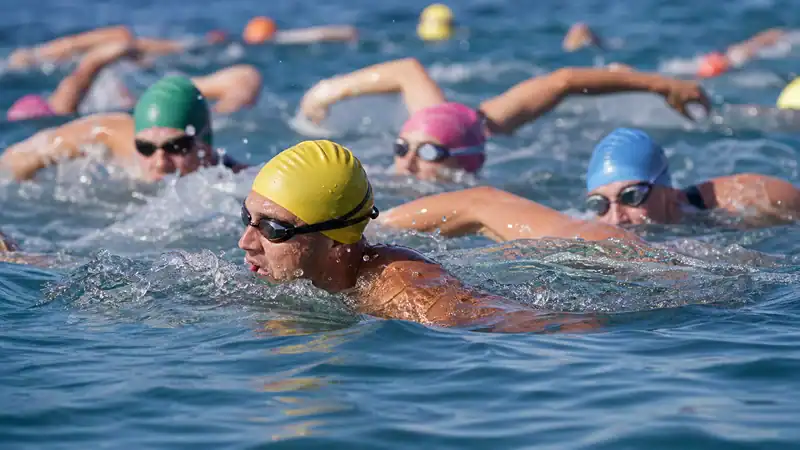
You’re at the front of a triathlon swim start. 200 people enter the water at the same time. Arms and legs everywhere. One elbow grazes your head and… your goggles are gone.
Pool racing is controlled. You dive from a block in your assigned lane, clean entry, no contact.
Open water is a different sport entirely. It’s a contact start – bodies colliding, arms swinging, heads bumping – and any over-cap training setup will not survive the first 20 meters.
This is why the double-cap method is the open water standard:
- The outer cap holds straps in place even if your head takes a glancing blow from another swimmer’s arm.
- If the outer cap gets knocked off entirely – it happens – the inner cap provides a backup layer of retention.
- Some triathletes add a wide elastic band over the outer cap as additional insurance, but double-cap alone is the baseline.
There’s one more thing most triathletes don’t know until race day: most triathlon events require you to wear the race-issued swim cap. So you’re double-capping whether you planned to or not – the race cap goes on top of your own cap. Plan for it. Put your goggles under your cap as normal, then add the race cap last.
Goggles with split straps or bungee straps tend to stay put better in contact starts because they sit flatter and distribute pressure differently than single clip-style straps. Worth considering if open water starts are a regular part of your season.
Your Race-Day Setup – In the Right Order Every Time
| Scenario | Setup Order |
|---|---|
| Pool training | 1. Cap on. 2. Goggles on over cap. 3. Adjust strap. Done. |
| Pool racing (single cap) | 1. Goggles on bare head. 2. Cap over straps. 3. Verify cap edge sits above gasket. |
| Pool racing (double cap) | 1. Latex/thin inner cap on. 2. Goggles on – suction test. 3. Outer silicone cap over straps. 4. Check cap edge above gasket. |
| Open water / triathlon | Same as double cap, then: 5. Race-issued cap on top if required by race rules. |
Run through this once on the pool deck before a big meet – don’t leave setup to habit on race day.
A 10-second check saves you the misery of adjusting goggles on the block.
Cap and Goggle Questions I Hear Every Single Season
Should you put goggles on before or after your swim cap?
It depends on the method. For the double-cap racing setup, goggles go on before the outer cap – inner cap first, then goggles, then outer cap over the straps.
For over-cap training, the cap goes on first and goggles sit on top. The method determines the order, not the other way around.
What is double capping and how do you do it correctly?
Double capping means wearing two swim caps simultaneously with goggles sandwiched between them. The three steps:
(1) put the inner cap – usually latex – directly on your head;
(2) seal your goggles on the outside of the inner cap, run the suction test;
(3) pull the outer silicone racing cap over the goggles, pressing the straps flat.
The key check throughout: make sure the outer cap’s edge never overlaps the goggle gasket. See the main double-cap section above for the full detail on common mistakes.
Why do my goggles leak when I wear them under my swim cap?
Nine times out of ten, the outer cap’s edge has slid down over the goggle gasket. That cap edge applies outward pressure on the seal, breaking it.
The fix: after pulling the cap down, confirm the cap rim sits above the gasket on the forehead side. This is the most common cause of leaks that appear specifically after the cap goes on.
Do professional swimmers wear goggles over or under their cap?
At competition, elite pool swimmers wear goggles under the cap – or use the double-cap method for championship-level security on race starts and turns.
In training, most wear goggles over the cap for convenience, including at the Olympic level.
The USMS community thread notes this split is near-universal: over-cap for practice, under-cap for racing.
Can wearing your swim cap over your goggles damage the cap?
Over time, yes – particularly with latex caps. The goggle frame and straps create localized pressure points that can thin or crack latex at the contact areas faster than normal chlorine and UV degradation would.
Silicone caps are more durable and less susceptible, but they still show wear where straps press against them over hundreds of sessions.
If cap longevity matters to you, double-capping keeps the strap pressure between the two caps and off the outer surface of both – which is one of the less obvious benefits of the method.
One Cap, Two Caps, or None – You’ll Know the Right Call After This
One habit change – cap edge above the gasket, straps under for race day – is the difference between goggles that stay put and goggles you’re peeling off the lane floor. Most swimmers only learn this the hard way.
Pick the method that fits your context, run it at practice first… and it’ll be automatic by the time you step on the block.
Disclosure: This article features AI-assisted imagery to help provide a more intuitive and visual reading experience.

 How to Avoid Goggle Eyes – Fix the Fit Before You Touch the Strap
Leave a Reply