
I had a swimmer show up to an outdoor morning practice last summer with pitch-black mirrored goggles – gorgeous pair, looked like a pro.
The problem? We train indoors Tuesdays and Thursdays. She spent half the set squinting at the pace clock, convinced it was broken.
It wasn’t broken. Her lens was the wrong one for the environment.
That one swap – from mirrored to clear – changed her interval awareness overnight. Most swimmers spend serious money on goggles and zero time thinking about the lens. The swim goggle lens types explained here aren’t just gear trivia. They’re the difference between seeing the wall clearly at 5am and swimming into it.
🏊 Quick Summary – Key Takeaways
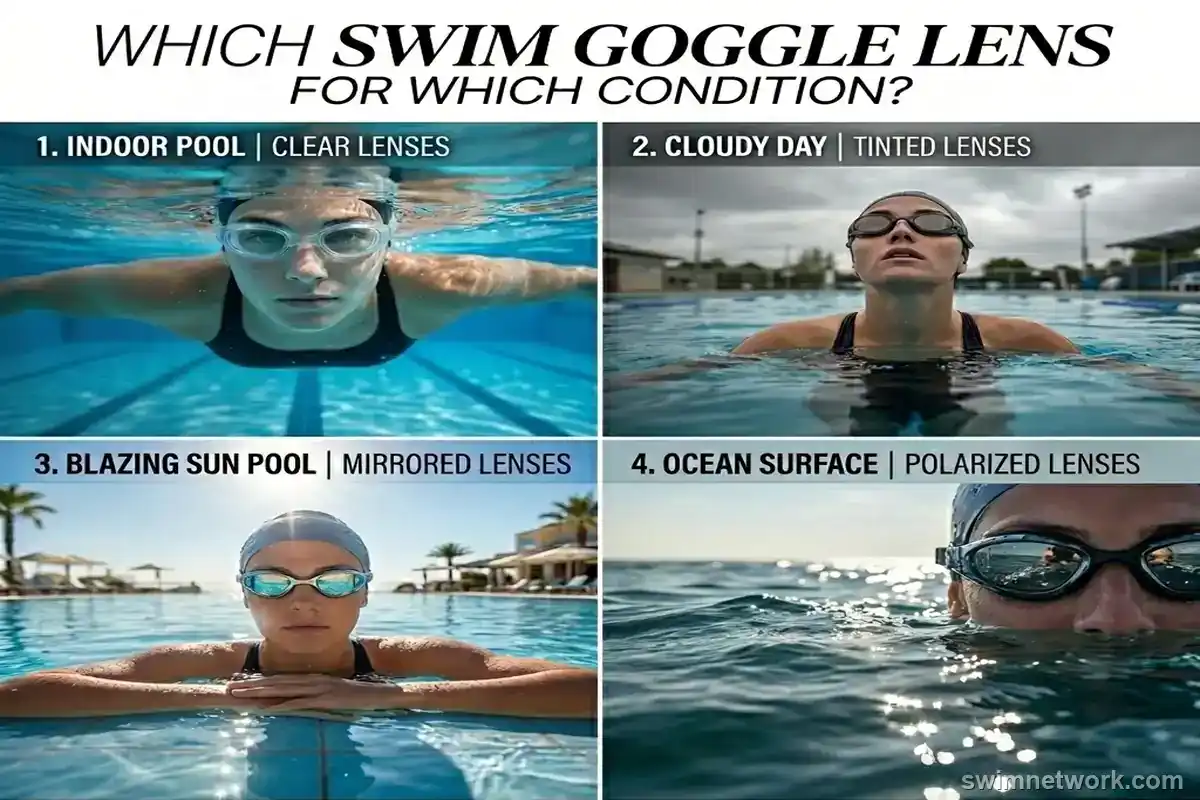
- Clear lenses let in the most light – they’re built for indoor pools and low-light conditions.
- Tinted lenses (smoke, blue, amber) are versatile all-rounders that cut moderate brightness without blacking out your vision.
- Mirrored lenses reflect direct sunlight away from your eyes – ideal for bright outdoor pools.
- Polarized lenses go further – they block the horizontal glare that bounces off open water surfaces specifically.
- UV protection is a separate coating – a dark lens without it can actually increase your UV exposure.
⚠️ Safety Disclaimer & Target Audience
Best for: Swimmers and triathletes trying to optimize their vision across different training and racing environments.
Coach’s reminder: Goggles protect against chemical irritation and UV damage during swimming. However, if you experience persistent eye pain, redness, or light sensitivity after sessions, have it evaluated by a medical professional – don’t chalk it up to “just chlorine.”
Swimming Indoors or in the Dark? Why Clear Lenses Are Your Best Bet
Clear lenses have one job, and they do it exceptionally well: they transmit as much visible light as possible into your eye without filtering, tinting, or distortion.
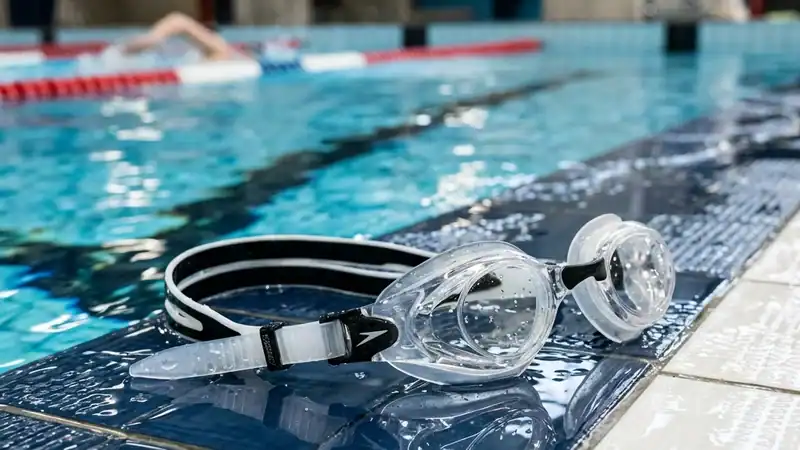
In an indoor pool with fluorescent lighting overhead, or during a pre-dawn outdoor session, your eyes are already working hard to gather every bit of available light.
A tinted or mirrored lens in that environment cuts down your light input and forces your pupils to dilate further – making everything dimmer, not sharper.
I tell my athletes this: if you’re swimming before 7am or indoors under artificial lights, the clear lens IS the performance lens. Full stop.
There’s also a safety argument. During warm-up, lanes get crowded. Seeing the swimmer coming off the wall at the other end isn’t just helpful – it’s how you avoid a head-on collision. Mirrored goggles in a dim indoor pool are a real hazard I’ve witnessed cause actual injuries.
If you’re exploring the full range of goggle options, our roundup of the 22 Best Swimming Goggles in 2026 includes strong clear-lens options at every fitting style.
The Tinted Lens Sweet Spot – Smoke, Blue, and What Amber Actually Does
Tinted lenses are the most misunderstood category. Swimmers either dismiss them as “less than mirrored” or grab them randomly without knowing what the color actually does.
Here’s what each tint does at the optical level:
Smoke / Grey: The most neutral tint available. It reduces overall brightness without shifting your color perception – what you see is basically a dimmer version of reality. This is the best all-around tint for variable outdoor conditions, overcast days, or pools with unpredictable skylight exposure.
Blue: Filters out the warm-spectrum wavelengths that create surface-level pool glare. Blue lenses are particularly effective in outdoor pools where light bounces off the water line. They don’t darken as aggressively as smoke, which makes them good for swimmers who train across both indoor and outdoor pools in the same day.
Amber / Yellow: This is the one coaches love and most swimmers overlook. Amber lenses actually enhance contrast in flat light – the kind of dull, overcast morning where everything looks grey and depth perception goes flat. If you do a lot of open water buoy navigation in low-contrast conditions, amber lenses are a legitimate performance tool.
The GTN team did an excellent breakdown of how these tint variations affect real swimmer perception. Watch it below – their demonstration of amber in flat conditions especially is worth your time.
📹 Video Quick Recap:
- Clear lenses provide the true baseline of visibility with zero light filtering.
- Smoke and blue tints manage moderate outdoor brightness without eliminating peripheral awareness.
- Amber enhances depth perception in flat-light conditions – particularly useful for open water navigation.
Polarized vs Mirrored: Which One Actually Stops Blinding Reflections?
This is the question I get most from triathletes preparing for their first open water race. And it’s a genuinely important distinction – because the two lenses work through completely different physics.
Mirrored lenses use a thin metallic coating on the outer lens surface. That coating reflects a broad spectrum of light away from your eye – like a mirror on your face. They’re excellent when the issue is total light intensity (a blazing noon sun hitting a calm, outdoor pool). They also have a psychological edge in competition: opponents can’t see where your eyes are tracking.
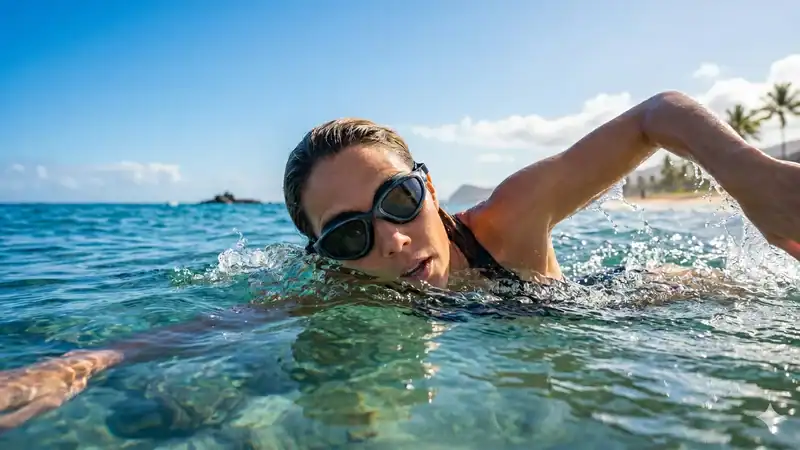
Polarized lenses work differently. They contain a chemical filter layer oriented to block horizontal light waves specifically. Why horizontal? Because sunlight bouncing off a flat water surface – or wet road – reflects predominantly in a single horizontal plane. That’s what creates the blinding, silvery glare you see when sighting during an open water swim.
Mirrored lenses reduce the overall volume of light entering your eye. Polarized lenses eliminate a specific type of light – the kind that causes the worst visual interference in open water.
According to USA Triathlon’s guide to choosing the right goggles, polarized lenses are particularly recommended for open water and triathlon events where surface glare is a consistent navigational hazard.
💡 Coach’s Bottom Line
If you’re in a bright outdoor lane pool, mirrored is your lens. If you’re in open water dealing with surface glare and sighting buoys through blinding reflections, polarized wins every time.
How Do Open Water Swimmers Choose the Right Lens on Race Morning?
This is where experience matters more than theory.
Race morning light changes fast. A 7am triathlon start can mean swimming directly into a low eastern sun on the way out – and then swimming back with it behind you.
I’ve seen athletes destroy their sighting (lifting your eyes above the water line to spot a buoy or landmark) by grabbing polarized lenses appropriate for the return leg without accounting for the intensity of direct glare on the way out.
Here’s what I recommend for race-day lens selection:
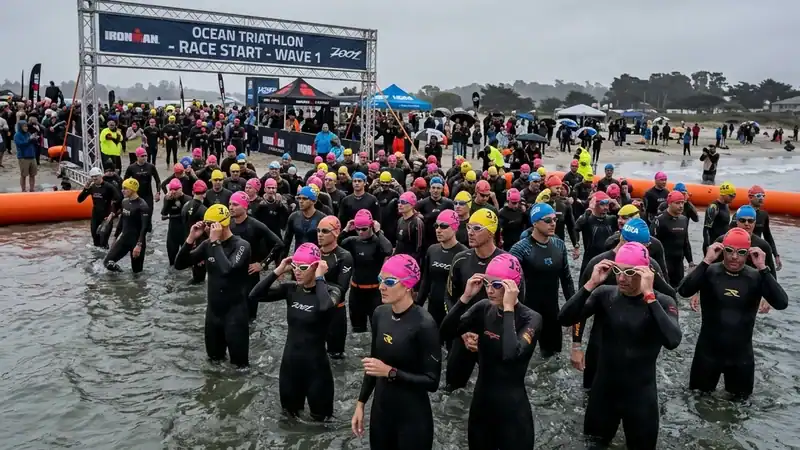
Check sunrise direction against your swim course the night before. If the first leg takes you eastward in the morning, you want polarized and a tinted base (not clear polarized). If sunrise is on your back or to the side, mirrored is often sufficient.
Overcast race day? Ditch both. Polarized lenses in a genuinely dark cloud cover cut too much light for sighting accuracy. Amber tint is the professional move on a flat-light race morning.
Always pack two pairs: one mirrored, one clear or amber. That 5-minute pre-race lens swap has saved more than a few athletes I’ve coached from a terrible sighting round.
According to USA Swimming’s Open Water Swim Essentials, having appropriate eyewear for varied conditions is a core component of open water safety readiness – and it starts with knowing your lens types before race day.
Don’t Hit the Ocean Without High-Grade UV Protection
Here’s something that surprises almost every swimmer I tell it to: the darkness of a lens tint has nothing to do with its UV protection.
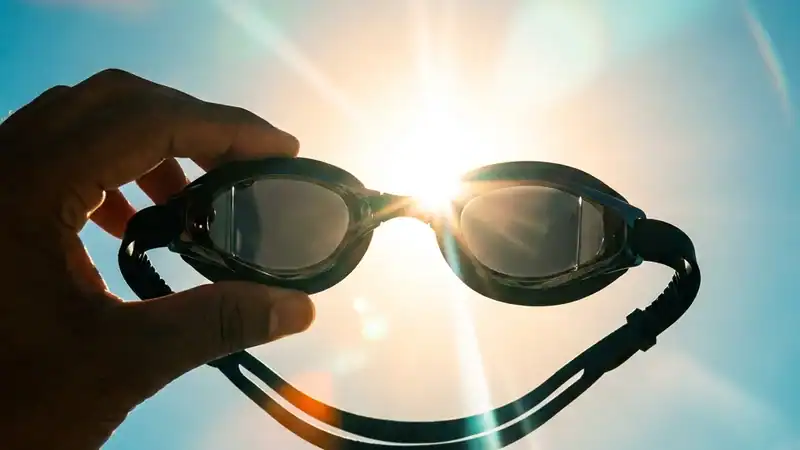
A pitch-black mirrored lens with no UV coating is actually more dangerous for your eye health than a clear lens with UV400 protection. As the American Academy of Ophthalmology confirms, dark lenses without UV filtering cause your pupils to remain larger – meaning more unfiltered UV radiation enters your eye than if you wore no eyewear at all.
UV protection in quality swim goggles is an invisible, separate chemical coating applied to the lens surface. According to the AAO’s sunglasses guidance, UV400 is the standard that confirms lenses block light rays up to 400 nanometers – covering 99-100% of both UVA and UVB radiation.
Before buying any goggle for outdoor use, confirm it lists UV400 protection explicitly in its specifications. “UV protection” alone without the 400-nanometer classification may only partially filter harmful wavelengths.
Once you’ve confirmed UV coverage, fit should be your next non-negotiable. Our guide on how to choose the perfect swimming goggles covers seal depth, nose bridge sizing, and pressure distribution – everything that affects whether those UV-protected lenses actually stay on your face.
Four Habits That Destroy a Good Lens in Week One
You can have the perfect lens for your environment and still destroy it in week one. Here’s what I see happen constantly:
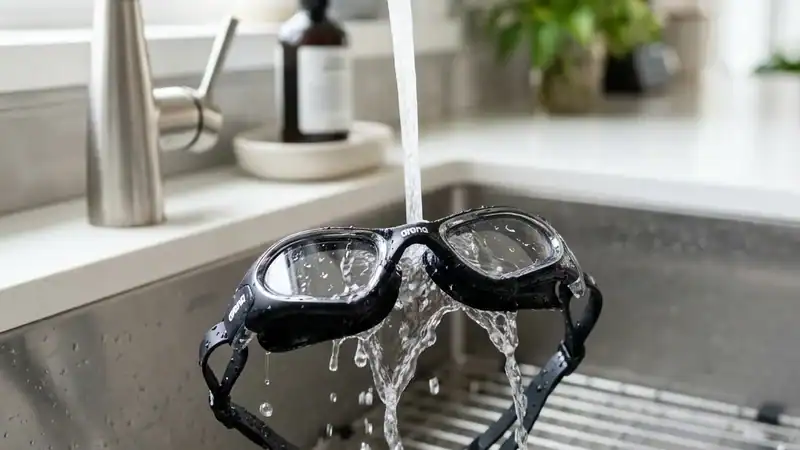
Wiping the inside of a new lens. The anti-fog coating on the inner surface of swim goggle lenses is applied as an extremely thin chemical layer. The first time you wipe it – even with a “lint-free” cloth – you physically remove part of it. Rinse, don’t wipe. Always.
Using hot water to rinse. Hot water degrades the silicone gasket seal faster and can cause the reflective metallic coating on mirrored lenses to lift or bubble. Cold water, thorough rinse, air dry.
Storing goggles in direct sunlight. UV radiation breaks down polycarbonate lens material over time and accelerates the degradation of the UV protective coating – the very thing you’re relying on. Keep them in a case, in your bag.
Touching a mirrored outer coating to remove smudges. The metallic reflective layer on a mirrored goggle sits on the outside of the lens, exposed. Any rubbing – finger, cloth, towel – scratches it. The smudge you’re trying to remove is less damaging than the micro-scratches that replace it.
Our full breakdown of how to keep your swimming goggles from fogging up covers anti-fog maintenance, rinse technique, and storage in detail.
The Lens Questions I Hear Every Single Season
Will a polarized lens make it harder to see underwater?
Generally, no – but there is one nuance worth knowing. Polarized lenses block horizontal light waves. Underwater, light scatters in multiple directions, so the polarization effect is minimal during the actual swim.
Where you’ll notice it is at the surface, particularly when trying to sight. Some swimmers find that very strong polarization makes the goggles feel slightly darker at the water line – which is exactly the trade-off you want when dealing with surface glare.
Are photochromatic swimming goggles worth the high price tag?
For athletes who regularly train or race across wildly different light conditions – say, an outdoor masters swimmer who sometimes trains at 5am and sometimes at noon – photochromatic lenses are genuinely useful. They darken automatically in bright sunlight and lighten in shade or indoors.
The limitation is that the transition isn’t instant, and they’re often heavier than standard polycarbonate lenses. For most recreational swimmers, a clear pair and a mirrored pair covers 95% of scenarios at a fraction of the cost.
Can I wear mirrored goggles in an indoor pool?
Technically yes, but it’s not advisable. Modern indoor pools with LED overhead lighting aren’t dark enough to make mirrored goggles dangerously dim for the average swimmer.
However, you will see less clearly, your eyes will strain harder to adapt, and visibility of fast-moving lane mates during warm-up will be genuinely reduced. Save the mirrored pair for outdoor use.
My Practical Recommendation After Years on the Pool Deck
Choosing the right swim goggle lens isn’t the most glamorous part of training preparation. But it’s one of those 5-minute decisions that affects every session you swim afterward.
My practical recommendation: start with two pairs. A good clear lens for indoor and early-morning training. A polarized or mirrored lens for outdoor and open water. From there, you can layer in amber tints for flat-light race mornings or smoke tints for variable conditions. If you haven’t bought your first pair yet, the roundup of goggles for new swimmers covers 8 options chosen for fit adjustability and clear-lens visibility — the two things that matter most at the start.
Your eyes are doing real work every time you’re in the water. Give them the right tool. Lens choice is one part of the decision — if you’re also working through fit, gasket seal, strap type, or care, our swim goggles guide covers the full selection process in one place.
When you’re ready to find specific goggle models across every lens type, our full swimming goggles guide covers the top picks for every category and fit shape.
Disclosure: This article features AI-assisted imagery to help provide a more intuitive and visual reading experience.

 How to Choose the Perfect Swimming Goggles: Fit, Sizing, and Comfort
Leave a Reply