
You push off the wall, put in a solid hour, and climb out of the pool. Eyes red. Vision blurry. That familiar sting that makes you look like you’ve been crying since 1987.
Most swimmers blame the chlorine. They’re only half right.
If you’ve ever wondered whether swim goggles actually protect your eyes from chlorine – and from the salt water in the ocean – the honest answer is yes. But the mechanism is more specific, and the limits are more real, than most people realize.
In this article we’ll work through three things: what actually irritates your eyes in the first place, what goggles do mechanically to stop it, and when they stop doing their job.
This matters… especially if you swim regularly in both pools and open water.
🏊 Quick Summary – Key Takeaways
- The real irritant in pools is chloramines (combined chlorine + organic matter from sweat and urea) – not free chlorine at normal levels
- Saltwater stings because of osmotic stress – seawater is roughly 4× saltier than your natural tear film, and that concentration difference pulls water out of your corneal cells
- Well-fitted goggles create a watertight mechanical barrier – but only as long as the seal holds
- Goggles reduce exposure to irritants and pathogens; they don’t eliminate risk from airborne chloramines or seal failures
- Contact lens wearers face an additional risk even under goggles – pathogens can be trapped against the lens surface regardless of seal integrity
⚠️ Safety Disclaimer & Target Audience
Best for: Any swimmer who experiences eye irritation in pools or open water, or who wears contact lenses while swimming.
Medical note: This article covers general eye health information. Persistent eye pain, redness, or vision changes after swimming should be evaluated by an eye care professional.
What Chlorine and Salt Water Do to Your Eye Surface
Let me set something straight that trips up even experienced swimmers.
Free chlorine at normal pool concentrations – 1–3 ppm per CDC guidelines – does not directly cause that burning sensation.
What does? Chloramines. Specifically trichloramine (NCl₃), the most volatile chloramine compound formed when chlorine reacts with nitrogen-containing contaminants – sweat, urea, body oils – that swimmers bring into the pool.
Research published in a large study of indoor pool workers confirmed that trichloramine – not free chlorine – is the compound most associated with ocular, respiratory, and skin irritation.
The mechanism: trichloramine is volatile. It rises off the water surface as a gas and comes into direct contact with the mucous membranes of the eye. That’s why indoor pools with poor ventilation feel harsher on your eyes than outdoor pools running the same chlorine level.
In other words, the “pool smell” you associate with heavy chlorination is actually the smell of too little – too little chlorine to break down the organic waste accumulating in the water.
Now shift to the ocean. The mechanism is completely different.
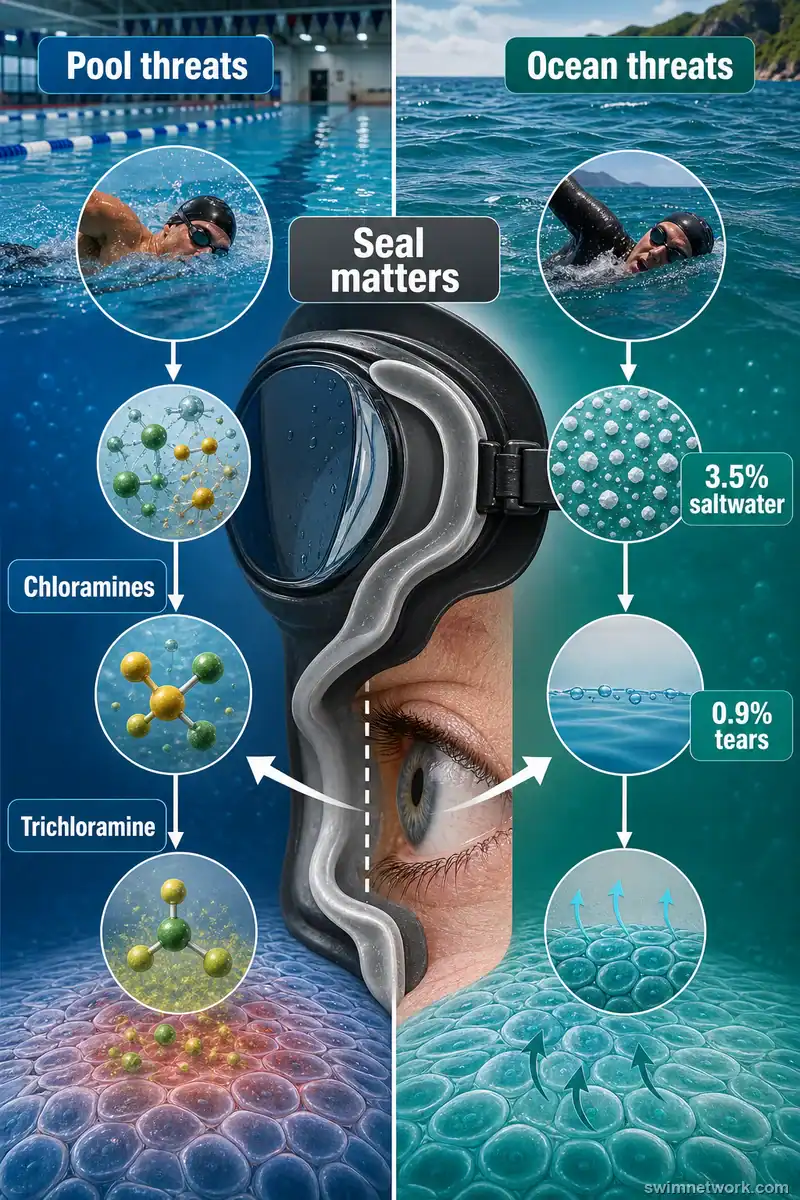
Seawater carries roughly 3.5% NaCl – about 35 grams of salt per liter. Your natural tear film sits at approximately 0.9% NaCl.
When hypertonic seawater contacts your corneal epithelium, basic osmosis kicks in: the concentration gradient pulls water molecules out of your corneal cells and into the saltwater. That’s osmotic stress.
It’s why ocean swimming produces a distinct sting – heavier, more enveloping than the chemical burn of pool irritation – and why blurred vision and temporary corneal cloudiness are more common after open water sessions.
Both mechanisms – chloramine chemistry in pools, osmotic pull in the ocean – disrupt the tear film and can trigger temporary inflammation of the conjunctiva. They’re different threats. Same tool protects against both.
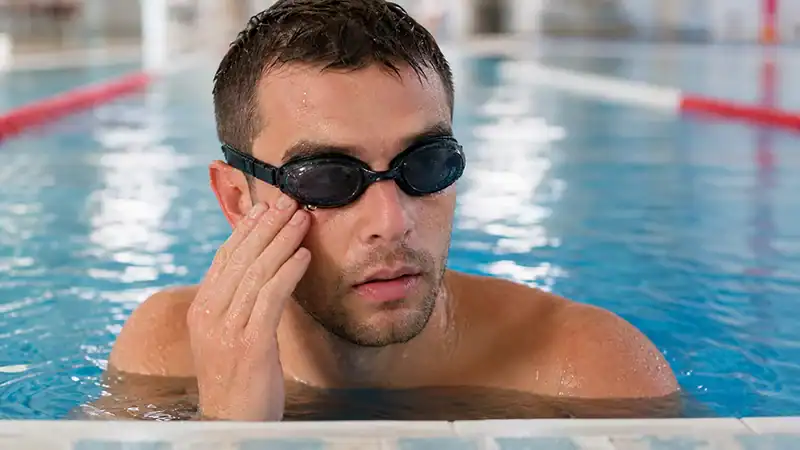
The Tear Film Your Eye Uses Before the Goggle Takes Over
Your eye has its own built-in defense layer: the tear film. It’s a thin, three-layer structure – a mucin base sitting directly on the corneal epithelium, an aqueous middle layer, and a lipid outer layer that slows evaporation.
The tear film is the eye’s first responder. It neutralizes minor environmental irritants, maintains optical clarity, and keeps the corneal surface from drying out.
Both chloramines and hypertonic seawater compromise it by disrupting the lipid outer layer and washing away the aqueous middle layer – leaving the corneal surface temporarily exposed to direct chemical or osmotic contact.
When the tear film fails, your eyes don’t just feel uncomfortable. They’re genuinely more vulnerable.
The Science Behind Whether Goggles Work
The mechanical logic of goggle protection is simple, and that simplicity is actually what makes it work.
A goggle’s silicone gasket creates a watertight seal between the goggle frame and the eye orbit. When that seal is intact, pool water and ocean water cannot contact the corneal surface. The primary irritant contact point – the eye itself – is physically removed from the equation.
The CDC’s Healthy Swimming program specifically recommends wearing goggles to prevent eye irritation from pool chemicals. This isn’t a general wellness suggestion; it’s recognition that the physical barrier is the single most effective intervention available to a swimmer.
A comprehensive review of water-related ocular diseases found that both pool and ocean water are documented causes of allergic conjunctivitis, and goggles are specifically recommended as a mechanical barrier against irritants and pathogens.
The review covers exposure in both environments – which matters if you’re an open water swimmer or a triathlete moving between pools and the sea.
Polycarbonate lenses add a second layer of benefit for outdoor swimmers. Most quality goggles rated for open water or outdoor training block UVA and UVB radiation – relevant because water surfaces amplify UV exposure and prolonged unprotected sun exposure at the eye is a real long-term health concern.
📹 Video Quick Recap:
- The goggle seal – not brand or price – is the single factor that determines whether you’re protected
- Small-socket vs. larger mask designs affect seal geometry; a goggle that looks right may leave a gap at the bridge or temple
- GTN demonstrates how goggles that appear fitted can still allow water ingress on dives and flip turns
- Strap tension is often the last thing to adjust – proper fit comes from lens shape and gasket contact first
- The “suction test” (pressing goggles to the face without the strap) is the most reliable dry-land seal check
💡 Coach’s Bottom Line
The Bottom Line: Goggles work as a physical barrier between your eyes and the water. When the seal is intact and the fit is correct, they significantly reduce your exposure to chloramines in the pool and salt irritation in the ocean. The keyword is seal.
The Seal Is Everything – Not the Lens, Not the Frame
Here’s what I tell swimmers who ask why their eyes still burn after an hour in the pool despite wearing goggles: a goggle that looks well-fitted but has a gap in the seal provides zero chemical barrier at that contact point.
Water doesn’t negotiate. It flows into any break, any gap at the nose bridge or along the temple edge, with the same ease as if you were swimming without goggles at all.
As the GTN video shows, goggles that appear snug on land can allow water ingress on dives when the pressure changes. No seal. No protection. That’s not an exaggeration – it’s the binary reality of how the barrier works.
The Pool and the Ocean Attack Your Eyes Differently – One Tool Stops Both
The threats aren’t the same. The way goggles neutralize them is.
In the pool, the primary ocular threat is chloramines – formed when free chlorine reacts with the nitrogen compounds every swimmer introduces (sweat, urine, body oils).
Trichloramine is volatile; it rises off the surface and doesn’t stay dissolved. Microbial exposure is a secondary concern in poorly maintained pools where pH and chlorine balance slip below acceptable ranges.
In the ocean, the threat profile shifts. The primary irritant is osmotic stress from high salinity – seawater is roughly 4× more concentrated than your tear film, and repeated exposure triggers the cellular water-loss mechanism described earlier.
A review of water-related ocular diseases documents ocean bacteria and organic matter as secondary concerns – pathogens not neutralized by chlorine, because there is no chlorine.
UV reflection from the water surface is a tertiary threat specific to outdoor ocean swimming, not present in an indoor pool.
In both environments, the goggle’s silicone gasket functions the same way: create a seal, exclude the water, eliminate direct contact with the eye surface.
Goggles that seal correctly in a 25-yard indoor pool will seal correctly in the Atlantic. The tool is universal. The effectiveness is always determined by one thing – the seal.
If you swim regularly in open water or an outdoor pool, UV-blocking lenses add a meaningful layer of protection. Look for goggles rated UV400 – that designation means the lens blocks 99%+ of UVA and UVB radiation.
Indoor swimmers don’t need that specification from their goggles, but it doesn’t hurt if it’s there.
Salt Water Doesn’t Just Sting – It Draws Water Out of Your Cells
Here’s the osmotic mechanism in concrete terms.
Your natural tear film sits at approximately 0.9% NaCl. Seawater is roughly 3.5% NaCl – nearly 4× more concentrated. When hypertonic seawater contacts the corneal epithelium, osmosis pulls water molecules out of corneal cells and toward the higher-concentration seawater.
Your cells are literally giving up water they need. And it stings.
This is why ocean eye irritation feels different from pool irritation – heavier, more diffuse, slower to clear. The chloramine effect is a chemical surface burn. The seawater effect is a cellular water deficit.
Goggles address both by preventing the contact. But it’s worth understanding which one you’re dealing with, especially if you’re moving between environments during a triathlon or open water training block.
In other words: the type of irritation differs. The solution doesn’t.
What Goggles Don’t – and Can’t – Stop
I want to be direct here, because overstating goggle protection does swimmers a disservice.
Three specific limits are worth knowing – not to scare you off goggles, but so you understand how to get the most out of them. That starts with choosing a pair that seals consistently — our swim goggle selection guide covering fit, seal, and care covers the full process in one place.
1. Airborne chloramine exposure. Goggles cover your eye surface. They don’t filter the air around your face. Trichloramine is volatile – it rises off the pool surface and hangs in the air above the water.
Swimmers and pool workers who spend long stretches near indoor pools are exposed to airborne chloramines regardless of whether they’re wearing goggles. The CDC notes that airborne chloramines around pool decks are a known cause of eye, nose, and respiratory irritation.
Goggles protect the eye surface from liquid contact. The surrounding conjunctival tissue and mucous membranes outside the seal perimeter are still exposed to air.
2. Seal failure. Any gap in the gasket – at the nose bridge, temple edge, or caused by strap overtightening that distorts the gasket shape – means water is entering. If your goggles are leaking, the chemical barrier for that contact point doesn’t exist.
Overtightening straps can improve the initial seal on dry land but distort the gasket under water pressure, creating the opposite effect.
And if you want to understand how goggle pressure affects your eyes – including the intraocular pressure concern from overtightened straps – that’s a separate issue worth understanding alongside protection.
3. Splash and spray outside the seal perimeter. The conjunctival tissue immediately around the goggle gasket can be contacted briefly by splash or spray that lands outside the seal area. This is a minor concern in steady lap swimming; it’s more relevant in crowded open water starts.
None of these limits make goggles not worth wearing. They remain the single most effective tool available for protecting your eyes in the water. Knowing the limits means you use them correctly – and don’t assume a leaking goggle is still doing its job.
Wearing Contacts Under Goggles Still Puts Your Eyes at Risk
A lot of swimmers believe that goggles make contacts safe in the water. I hear this regularly at the pool deck, and I understand the logic – if the goggle seals, nothing gets in, right?
The problem is that the logic breaks down at two points.
First, soft contact lenses are porous. They absorb pool water – and any organism dissolved in it – through the lens material itself. Goggles reduce the total volume of water that contacts the lens, but they do not create a perfectly sterile environment.
Any seal failure delivers contaminated water directly onto the lens surface. And even when the seal holds perfectly, the lens was placed in the eye before the goggle went on, which means whatever was on your fingers or in the air during application is already present.
Second, and this is the concern I want swimmers to take seriously: Acanthamoeba. It’s a microscopic, chlorine-resistant protozoan found in natural water sources and occasionally in treated pool water. Contact lenses absorb pool water, and Acanthamoeba can become trapped between the lens and the cornea.
Dr. Rupa Wong, an ophthalmologist who has addressed this directly, explains that the infection risk is real – and the organism forms chlorine-resistant cysts, which means standard pool treatment doesn’t eliminate it.
Acanthamoeba keratitis is rare, but it can cause permanent vision loss and is notoriously difficult to treat — and it’s one of several reasons eye doctors advise against wearing contacts under swim goggles.
📹 Video Quick Recap:
- Acanthamoeba and bacteria in water can be trapped under contact lenses even when goggles are worn – the lens absorbs organisms through the lens material itself
- Goggle seal failures (and they do happen) deliver contaminated water directly onto the lens surface
- Pool water is not fully sterile – Acanthamoeba forms chlorine-resistant cysts that survive standard treatment
- Daily disposable lenses are the lowest-risk contact option if contacts are unavoidable – discard them immediately after the swim
- Prescription swim goggles eliminate the risk entirely; this is Dr. Wong’s preferred recommendation for contact lens wearers who swim
If contacts are unavoidable, daily disposable lenses are the lowest-risk option – they’re discarded immediately after the session, limiting ongoing pathogen accumulation on the lens surface.
The preferred solution, and the one most ophthalmologists recommend for regular swimmers: prescription swim goggles. They correct your vision, seal the eye environment, and eliminate the soft-lens absorption risk entirely.
The Goggle-and-Eye Questions I Get Every Season
Do swim goggles keep chlorine out of your eyes?
Yes – when the seal is intact. Goggles create a watertight barrier that keeps pool water, and the chloramines dissolved in it, away from the corneal surface.
The important clarification: it’s not free chlorine that causes eye irritation at normal pool concentrations (1–3 ppm). It’s combined chlorine – chloramines, specifically trichloramine – that forms when chlorine reacts with organic matter in the water.
A well-sealed goggle blocks both. No seal equals no protection at that contact point.
Is it safe to swim in the ocean without goggles?
Technically possible, but not recommended for regular open water swimmers.
Seawater is hypertonic compared to your tear film – roughly 4× more concentrated. Repeated exposure causes osmotic irritation, temporary corneal cloudiness, and redness as the concentration gradient pulls water from your corneal cells.
Ocean water also contains bacteria and organic matter not present in treated pools, as documented in research on water-related ocular diseases.
For casual swimmers, the risk is low and temporary.
For frequent open water athletes, goggles are strongly recommended.
Can Goggles Keep Pool Bacteria Out of Your Eyes?
Yes – when the seal is intact. Bacteria and pathogens in pool water need liquid contact with the eye surface to cause infection. A sealed goggle prevents that contact.
The caveat worth knowing: Acanthamoeba forms chlorine-resistant cysts, meaning even treated pool water is not fully sterile. Goggles remain the best available mechanical barrier.
Contact lens wearers should note that soft lenses can absorb pool water through the lens material itself, creating an additional infection pathway that goggles alone don’t fully address.
Do goggles block UV rays?
Many do – if the lenses are polycarbonate and UV-coated. Most quality swim goggles marketed for outdoor or open water use include UV400 protection, blocking 99%+ of UVA and UVB radiation.
Indoor pool swimmers don’t need UV protection from their goggles (the overhead lighting doesn’t emit meaningful UV). But if you’re swimming outdoors regularly – open water training, a lido, a sun-exposed outdoor pool – check the product specs for UV400 rating.
It’s a genuine benefit, not just a marketing feature.
Yes, Goggles Protect Your Eyes – If the Seal Holds
Yes. With one qualifier that matters more than any other spec or brand decision.
Well-fitted goggles with an intact seal significantly reduce your exposure to the chloramines in pools and the osmotic stress of ocean water.
The science backs them – the CDC recommends them, peer-reviewed research documents their effectiveness as a mechanical barrier, and the mechanism is straightforward: if pool or ocean water can’t contact your eye, it can’t irritate it.
The limit is always the seal. If your goggles fit correctly – no gap, no water ingress, no leaking at the nose bridge or temple – they’re doing their job. If they’re leaking, they’re not.
Start with choosing goggles that actually seal for your face geometry. Do the suction test before you get in the water. Check the nose bridge fit. Everything else – tint, anti-fog, strap style – is secondary to that first question: does the gasket actually seal?
Whether they hold through your entire swim is something only your fit – and a dry suction test before you jump in – can tell you.
Disclosure: This article features AI-assisted imagery to help provide a more intuitive and visual reading experience.

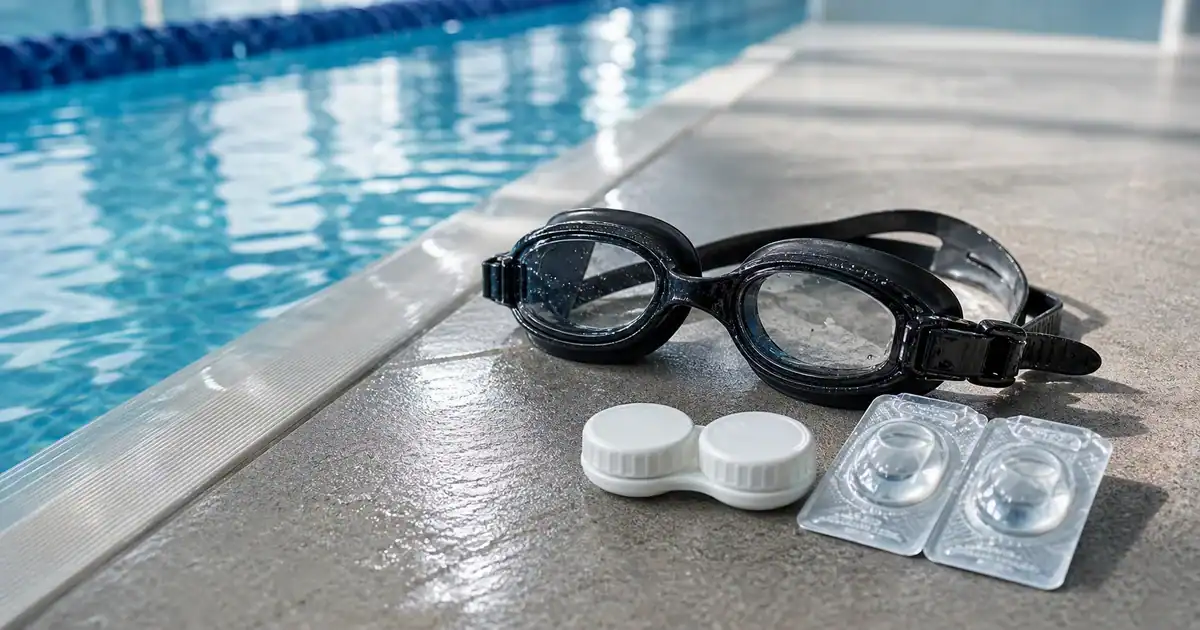 Can You Wear Contact Lenses Under Swim Goggles? Not Safely – And Eye Doctors Agree
Leave a Reply