
I’ve watched it happen on deck more times than I can count – a swimmer rips off their swim goggles halfway through a main set, presses the back of their hand into their eye, and shakes their head.
Fogged out. Leaking.
Or just leaving rings around their eyes deep enough to see from the other side of the pool.
The goggles weren’t defective. They just weren’t right.
Wrong size, worn wrong, never properly cared for – and the swimmer had no framework for fixing any of it.
That’s what this guide covers. Choosing swim goggles that actually seal on your face.
Using them in a way that doesn’t create more problems than the pool already does. And keeping them in working condition long enough to get full value out of them.
Three parts. You’ll need all three.
🏊 Quick Summary – Key Takeaways
- The suction test is how you verify goggle fit before buying – press the cups against your eye sockets without the strap and see if they hold for one to two seconds on their own.
- Strap tension holds position; the gasket creates the seal. Over-tightening can distort the gasket and worsen a leak instead of fixing it.
- Lens color is environment-driven: clear lenses for indoor pools, mirrored or tinted for outdoor and variable-light conditions.
- Avoid rubbing the inside of a standard coated lens because it can damage the anti-fog treatment; always follow the instructions for your specific model.
- Replacement timing depends on condition, not a fixed calendar: persistent visibility problems, a hardened or cracked gasket, and a brittle strap are the signals to watch.
⚠️ Safety Disclaimer & Target Audience
Best for: Beginner, fitness, competitive, open-water, and youth swimmers who need help choosing, fitting, using, or caring for swim goggles.
Not ideal for: Replacing individualized advice from an eye-care professional when a swimmer has glaucoma, another diagnosed eye condition, persistent eye pain, or recent eye surgery.
Safety note: This content is general guidance. Small studies have found that some goggles temporarily raise intraocular pressure while worn, so discuss goggle choice with your ophthalmologist if you have glaucoma or another condition affected by eye pressure.
The Fit Test Every Swimmer Should Do Before Buying
Many goggle problems start at the store – or worse, at the checkout page. A swimmer picks a pair based on how it looks, gets to the pool, and spends the next 45 minutes adjusting the strap trying to stop a leak that more tension will not fix.
The issue isn’t the strap. It’s the fit.
Before anything else, do the suction test. Press the goggle cups gently against your eye sockets without attaching the strap.
The cups should hold their position briefly on their own. If they drop immediately, the gasket isn’t sealing evenly against your orbital rim – that goggle is not the right shape for your face.
When the suction test fails, check the nose bridge first. The bridge controls how the lens cups sit relative to your eye sockets.
Too narrow and the cups tilt inward; too wide and they cant outward. Either can break the goggle seal before you even get in the water.
The gasket is what creates the seal – the strap only holds the goggle in position. For recreational and fitness swimmers, a wide gasket that spreads pressure across the orbital bone is often more comfortable than a narrow racing gasket and more forgiving across different face shapes.
If you’ve genuinely tried three or four different models and nothing seals without turning your strap into a tourniquet, one custom-fit option is The Magic5. Its current fitting process uses a smartphone face scan to shape the gasket to the swimmer’s orbital geometry.
That approach can reduce the trial-and-error of standard frame shapes, although you still need to check comfort and seal when the goggles arrive.
Read the full fit and sizing guide for the complete breakdown on suction tests, nose bridge sizing, and what to do when nothing seals.
Swim Goggles or a Swim Mask? The Activity Decides
This one comes up more than you’d expect, usually from open water swimmers who aren’t sure if a snorkel mask will do the job.
It won’t. Not for lap work or open water racing.
Swim goggles seal around the eye socket and keep a relatively low profile for forward movement through the water. Swim masks use a wider seal across the forehead and cheekbones and usually cover the nose.
That larger mask profile provides more facial coverage but adds bulk that can interfere with a lap swimmer’s or racer’s streamlined setup.
Open water swimming is a common point of confusion. Wide-view goggles are usually the better choice for open-water racing and triathlon.
They provide peripheral visibility for sighting without the bulk of a full swim mask.
If you’re still weighing both options, the complete goggles vs. masks breakdown covers each use case in full.
Kids and Goggles Don’t Have to Be a Fight
I’ve watched parents spend ten minutes at the pool deck trying to convince a seven-year-old that their goggles don’t hurt. Nine times out of ten, the goggles are adult-sized.
Children’s goggle frames are designed around smaller faces and narrower lens spacing. An adult frame may rest on the wrong part of a child’s face or place the nose bridge too wide for an even seal.
The result can be leaking, pinching, or pressure marks that make a child want to remove the goggles.
For kids, two features matter most: a soft gasket and a frame or nose bridge that fits the child’s lens spacing. A soft gasket spreads contact more comfortably across smaller facial contours.
An interchangeable bridge gives you another way to center the cups over each eye.
The strap is a secondary problem – if the gasket seals, the strap won’t need to be cranked tight to compensate.
Check the full kids goggle fit guide for sizing by age range and the specific features that keep goggles on without pinching.
Can’t See Clearly Underwater? Prescription Goggles Need the Right Numbers
Here’s a question I get from adult swimmers regularly: can they wear contacts under goggles?
Technically, a contact lens can remain under a goggle. The safer answer is to remove it before swimming.
CDC guidance warns that water exposure can make soft lenses swell or stick to the eye and can expose the cornea to infection-causing organisms, including Acanthamoeba. Read the CDC’s contact-lens water guidance.
Prescription swim goggles avoid wearing a contact lens in the water. Many OTC models come in fixed diopter increments, although whether the two lenses can differ depends on the model or modular lens system.
If you have significant astigmatism, a strong prescription, or a large difference between eyes, ask your eye-care professional whether a custom or separately configured option is appropriate.
Don’t try to estimate the diopter math on your own. The prescription goggle diopter guide walks through the step-diopter system and when custom ordering is the better call.
The Best Prescription Swim Goggles Match Your Level of Vision Correction
OTC prescription goggles are generally the less expensive route and cover common corrections in fixed steps. Custom-order models can account for more complex prescriptions, including astigmatism, but cost more and require more precise prescription details.
If your correction is mild and both eyes are close in strength, an OTC step-diopter model may provide useful underwater vision. With a strong prescription, a large difference between eyes, or astigmatism, standard options may not match both eyes or account for every part of the prescription.
The best prescription swim goggles roundup covers the top-performing OTC and custom options at every correction level.
What Racing Goggles Have That Training Models Don’t
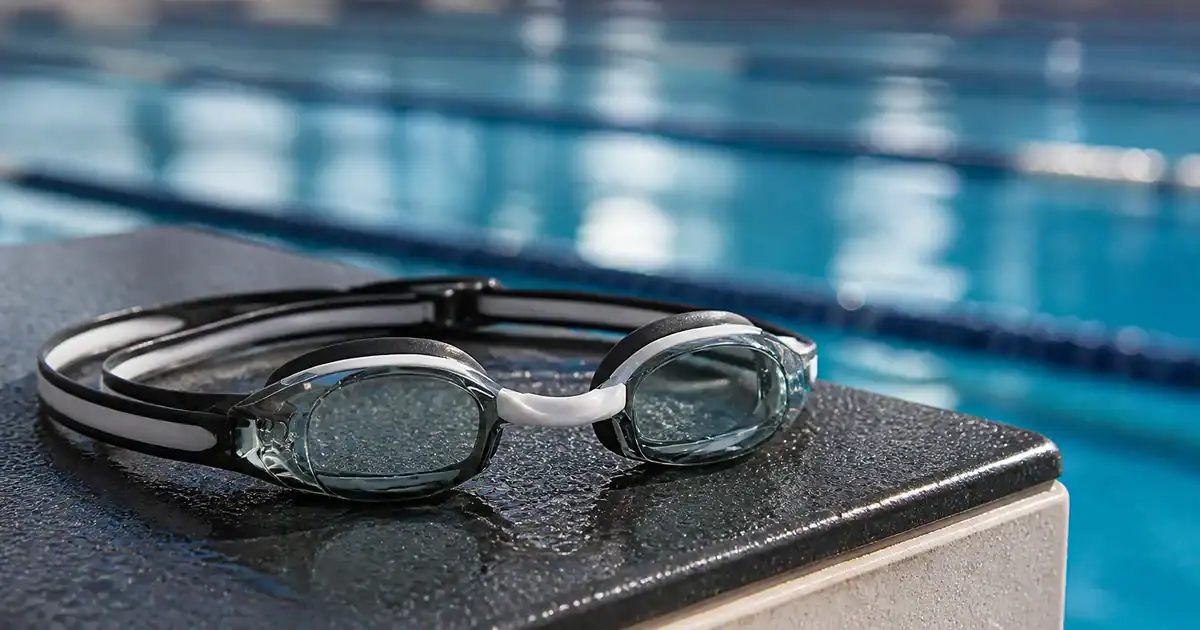
The difference between a racing goggle and a training goggle isn’t marketing. It’s three specific design choices that serve a very different purpose in the water.
First, lens profile. Racing goggles are lower-profile than comfort-focused training models.
Many seat inside the orbital rim rather than spreading a wide gasket across the outer orbital area. That placement reduces frontal profile and is intended to remain stable during starts and turns.
Second, strap type. Many racing models use dual or split silicone straps, with two bands positioned at different points on the back of the head.
The configuration spreads retention across two contact lines and can reduce strap migration. Some competitive swimmers also secure the straps beneath an outer cap.
Third, lens and frame options. Racing goggles come in mirrored, tinted, and Swedish-style no-gasket variants.
Mirrored lenses reduce brightness and glare in bright conditions, while blue, amber, rose, and smoke tints change light transmission and contrast. Swedish goggles sit at the minimalist end, with rigid cups against the orbital rim instead of a soft gasket.
In one 2021 computational fluid dynamics comparison conducted at 2 m/s, the Swedish model produced the lowest total drag of the three goggle designs tested. That result does not make every Swedish goggle universally fastest, and the rigid rim can feel less forgiving during long training sessions.
Polarized lenses are available in some racing lines, primarily for open water and triathlon where surface glare is a sustained issue.
Get the full comparison at what makes racing goggles different.
Swim Goggle Lens Types Work Differently in Changing Light
Lens color is an environment choice before it is a performance choice. The most useful tint depends on the light where you swim, not how fast you are.
Clear lenses transmit the most available light and are a practical default for dim indoor pools and low-light sessions. Bright indoor pools with strong overhead reflections or large windows may still call for a light tint, so judge the actual conditions instead of the roof alone.
Tinted lenses – blue, amber, smoke, rose – serve outdoor and variable-light conditions. Each tint shifts light transmission and perceived contrast differently.
Amber and rose can increase contrast in flat, overcast light. Smoke and darker tints reduce overall brightness in bright conditions.
Mirrored lenses add a reflective outer coating that reduces brightness and glare. They’re suited to bright outdoor conditions – outdoor pools and open-water venues where overhead sun or surface reflection is a sustained factor.
Polarized lenses filter horizontally reflected light specifically. That makes them especially useful in open-water swimming, where light bouncing off the water surface can interfere with sighting.
One point worth stating clearly: lens tint does not by itself determine whether your goggles fog. Fogging depends on condensation conditions, fit and ventilation, and the condition or type of anti-fog treatment.
Choose your tint for the light, then evaluate anti-fog performance separately.
The full lens type guide covers each tint option with specific environment and lighting scenarios.
The Best Beginner Swim Goggles Put Comfort Before Speed
I always tell new swimmers the same thing: the fastest goggle for you is the one you’ll actually keep on for the full session.
For beginners, that means three useful features: a soft silicone gasket that conforms without digging, an adjustable or interchangeable nose bridge, and an easy-adjust strap.
Together, they let you center the lenses and refine retention without cranking down the tension mid-session.
Low-profile lens cups and Swedish-style designs are usually a poor starting point when comfort and easy adjustment matter most. Their narrower fit tolerance can make first-time setup less forgiving.
Beginners need adjustability before they need a race-focused profile.
The best beginner swim goggles roundup walks through the top picks at every price point with those three criteria as the filter.
The Best Swim Goggles Change with the Swimmer Wearing Them
There’s no single best goggle. There’s only the best goggle for how you train and who you are in the water.
For recreational and fitness swimmers – the lap swimmer, the masters swimmer, the adult who swims three mornings a week – comfort, anti-fog care, and a forgiving soft gasket are the priorities. Brands such as Speedo and Aqua Sphere offer comfort-focused designs alongside their performance lines.
Competitive swimmers need a different profile entirely. Racing or high-training-volume swimmers often look for a low-profile lens cup, a stable split strap, and a lens tint matched to the competition environment.
Arena and TYR are two established brands with racing and training models, but face-specific fit still matters more than the logo.
For data-driven training, FORM swim goggles use an in-lens display for metrics such as pace, stroke rate, and length count. Metric availability varies by swim mode and connected device.
That lets a swimmer check supported metrics without stopping to read a poolside display or watch.
The full swim goggle rankings organize everything by swimmer type with specific picks at each level.
The Best Kids’ Swim Goggles Stay Put Without Pinching
Kids’ goggles and adult goggles are not interchangeable. The frame size is smaller, the gaskets are softer, and the strap systems are designed for heads that move a lot and parents who need to make adjustments quickly at the pool deck.
The parent priority when buying is straightforward: seal and comfort first, price second. A goggle that leaks on the first lap isn’t saving anyone money.
Look for a soft gasket and a frame sized for the child’s face, then verify both with a gentle suction test. Color and styling come after fit.
For the full breakdown of what to look for by age and face shape, the best swimming goggles for kids roundup covers the top picks with seal integrity and comfort as the primary filters.
Bungee and Silicone Goggle Straps Serve Different Swimmers
Many swimmers don’t think much about strap type. They should, because it can affect comfort and stability over long sets.
Bungee straps offer fine tension adjustment and tend to pull less on hair than standard silicone straps. Some swimmers also prefer how the cord rests across the back of the head.
The trade-off is that a bungee may shift more readily if its tension or position is not set securely for fast turns and starts.
Silicone straps provide broad, elastic contact, although they can pull hair when worn directly against it. A swim cap can reduce that contact and help stabilize strap position.
For racing and competitive training, test the complete cap-and-strap setup during practice before relying on it at a meet.
Neither strap type can rescue a gasket that does not match your face. The gasket creates the seal; the strap holds the cups in position.
Head-strap tension is therefore a separate adjustment from seal quality.
The full bungee vs. silicone strap comparison goes into the specific scenarios where each excels.
Your Goggles Are Leaking Because You’re Tightening the Wrong Thing
A common reaction to a leaking goggle is tightening the strap another notch and hoping for the best. That often fails, and here’s why.
The strap doesn’t create the seal. The gasket does.
The strap’s job is to hold the goggle cup in position so the gasket can seal. If the gasket is the wrong curve, size, or profile for your face, extra tension may distort it and worsen the leak.
When you’re troubleshooting a leak, start with the suction test again with no strap attached. If the cups won’t hold for even a second, the gasket isn’t seating – the goggle isn’t the right fit for that section of your face.
Leak location gives you a useful clue. Water entering near the nose bridge often points to bridge spacing or cup alignment.
Water at the outer edge can suggest that the gasket profile does not match your face at that point. Re-center the cups and retest the fit before adding strap tension.
For the complete diagnostic walkthrough, the full leak diagnosis guide goes through every leak scenario by location.
Goggle Fog Has More Than One Cause
I’ve seen swimmers spit into their goggles before every session for twenty years and still wonder why they fog at lap thirty. Spit is a temporary solution to a permanent problem.
Many factory anti-fog treatments use a hydrophilic surface that helps moisture spread instead of forming vision-obscuring droplets. The exact treatment varies: some lenses use an applied inner coating, while others use a treatment incorporated during manufacture.
Either way, care requirements are model-specific, so check the instructions that came with your goggles.
For a standard coated lens, rubbing the inside can scratch or remove anti-fog treatment. Avoid touching that surface unless the manufacturer specifically instructs you to reactivate or clean its coating that way.
That exception matters for specialized products, so the model’s care directions outrank any blanket rule.
Lens tint by itself does not determine whether goggles fog. Fogging depends more on condensation, fit, ventilation, and the condition or type of anti-fog treatment.
Choose clear, tinted, or mirrored lenses for the light conditions, then evaluate anti-fog performance separately.
The two-layer approach is simple: preserve the factory treatment according to the manufacturer’s directions, then use a lens-compatible anti-fog product if visibility starts declining. A spray does not restore the original factory treatment, but it can provide a temporary surface treatment when used as directed.
For standard coated lenses, gentle rinsing, air-drying, and minimal contact with the inside surface are the safest defaults. Speedo’s current care guidance gives the same no-rub advice while noting that coating types vary.
The full anti-fog guide walks through the care routine and compares the available spray approaches.
The Anti-Fog Sprays That Work When the Coating Wears Off
Anti-fog spray is not a permanent fix, but it can extend clear use after the original treatment becomes less effective. Application method, lens compatibility, and how long one treatment lasts vary by formula.
Follow the spray label and the goggle maker’s care instructions instead of assuming that every product can be applied or wiped the same way.
Three criteria matter when choosing a spray: the maker must identify it as compatible with your lens material or coating, the application steps must be practical for your routine, and the treated lens must remain comfortable and clear during your normal session.
No specific products here – the best anti-fog sprays for swim goggles roundup compares options against all three criteria.
Deep Red Rings Usually Mean Too Much Pressure
Post-swim goggle marks are a frequent complaint I hear from swimmers who are new to training volume. Deep or persistent marks often mean the strap is tighter than needed or the gasket concentrates pressure on a small area.
Here’s the mechanic: when you over-tighten the strap, it forces the gasket to compress the soft periorbital tissue around your eye socket harder than necessary. That compression can deepen the red ring.
Even a properly fitted goggle can leave a temporary impression, but pain, swelling, or marks that linger are reasons to reassess the fit and tension.
Start by reducing strap tension to the minimum level that keeps the goggle in place. If the suction test holds without the strap, the gasket already matches the basic contours of your face.
The strap should maintain that position during movement, not create excessive pressure.
For swimmers who get chronic goggle marks regardless of strap tension, wide-profile cushioned gaskets distribute seal pressure across a larger contact patch. That reduces the localized compression that causes the ring.
The how to avoid goggle eyes guide goes through the full correction routine.
Cap Over or Under the Straps? Use the Setup That Stays Put
This is one of the questions I get most from swimmers moving up from recreational to competitive training, and the answer is different depending on whether you’re in a race or a practice.
World Aquatics’ February 2026 swimming rules allow an athlete to wear goggles and/or a cap, but they do not prescribe whether the goggle straps sit over or under the cap. Check the current World Aquatics competition regulations, along with any meet-specific instructions.
In training, choose the arrangement that stays secure without changing the goggle seal. Wearing the cap over the straps can help hold them in place, while straps over the cap are easier to adjust between repeats.
Test both during starts and flip turns. Cap fabric, strap material, hair, and head shape all affect which setup shifts less.
Some competitive swimmers double cap: one cap goes on first, the goggles sit over it, and a second cap covers the straps. This can lock the straps between the caps, but it is an optional stability method rather than a universal compliance requirement.
The full cap-over vs. cap-under breakdown covers competition compliance, training efficiency, and the double-capping technique in detail.
What Eye Doctors Say About Contacts Under Swim Goggles
The short version: don’t.
Pool water is not sterile. Water exposure can make a soft contact lens change shape, swell, and stick to the eye, increasing the chance of corneal irritation or infection.
One organism of concern is Acanthamoeba, which can cause a rare but severe corneal infection and permanent vision loss.
CDC guidance is direct: remove contact lenses before swimming. A watertight goggle seal may reduce water exposure, but it does not turn swimming in contacts into a risk-free practice.
If water touches your lenses, remove them as soon as possible and follow the CDC’s disposal or cleaning and disinfection guidance.
The safer long-term answer is prescription swim goggles. They correct vision without putting a contact lens against the cornea during water exposure.
Read the complete guidance from eye specialists at contacts under swim goggles – full eye doctor guide.
Pool Chemicals Irritate Eyes – Goggles Reduce Contact
Chlorine disinfects pool water, but it can combine with sweat, dirt, urine, and other material from swimmers to form chloramines. CDC guidance identifies chloramines as chemical irritants that can cause red, itchy eyes and respiratory symptoms.
Read the CDC’s pool-chemical guidance.
A well-fitting pair of goggles reduces direct contact between pool water and the eye surface. That can improve comfort and visibility, but goggles do not replace proper pool chemistry, ventilation, or medical evaluation for persistent symptoms.
The full evidence for goggle protection against chlorine and saltwater is in the cluster article – rather than restate the research here, I’ll point you directly to it: do goggles protect eyes from chlorine.
How to Swim With Extensions and Long Lashes Without Wrecking Them
This section is for swimmers with eyelash extensions – and for anyone with naturally long lashes who’s had them bent flat by a goggle lens.
The primary placement error is positioning the goggle gasket on the lash line. It should rest around the orbital area rather than pressing directly on the lash roots.
When the frame fits correctly, the lashes sit inside the cup with enough clearance from the lens surface.
Deep-cup designs create more internal clearance between the lens and the eye. More clearance means less chance of the lashes rubbing the inner lens.
For extensions, follow the adhesive maker’s curing window and your lash technician’s aftercare instructions before swimming. Use only products they identify as extension-compatible; a generic sealant can introduce ingredients that do not suit every adhesive system.
The full care protocol is in the full eyelash protection guide for swimmers.
The Four-Step Cleaning Routine That Keeps Anti-Fog Coating Alive
Four steps. That’s all this takes.
Most swimmers skip at least one of them.
Step one: rinse gently with fresh cool or lukewarm water, following the instructions for your model. Avoid very hot water and detergents unless the manufacturer explicitly permits them.
Step two: avoid wiping the interior of a standard coated lens with a cloth or finger. Direct rubbing can abrade the anti-fog treatment.
If your model uses a coating designed for reactivation by touch, follow that product’s instructions instead.
Step three: shake off excess water and do not towel-dry the inner lens. Towel fibers can rub against and damage a standard coating.
Step four: air-dry the goggles flat in a ventilated place away from direct sunlight. Once dry, store them in a protective case or pouch so the lenses do not rub against other gear.
These four steps don’t require extra equipment. They just require consistency.
The detailed breakdown – including what materials to use, how to handle a protective case, and what to do when the coating is already gone – is in how to clean swim goggles properly.
Three Signs Your Goggles Are Done – and When to Replace Them
Some swimmers replace their goggles only after a strap snaps mid-session or visibility fails at a race. Regular condition checks let you replace worn equipment before it disrupts a swim.
Three signals tell you it’s time:
First, persistent fogging or poor visibility despite correct care and a compatible anti-fog treatment. Before replacing the goggles, rule out residue, a poor seal, and an application method that conflicts with the lens instructions.
Second, gasket hardening, cracking, or loss of elasticity. A gasket that no longer compresses and recovers evenly cannot maintain a dependable seal.
Third, check for strap brittleness, cracking, or loss of stretch. A strap failure can end a pool session and create a more serious problem in open water.
Replace a damaged strap or the complete goggle before the material fails.
Condition signals matter more than any fixed replacement timeline because materials, care, storage, and training frequency vary. The when to replace your swim goggles guide walks through how to assess each signal.
Every Pair Has a Lifespan – Make Yours Count
Here’s the honest version of how goggle selection actually works. First, it has to fit – the suction test either holds or it doesn’t, and no amount of strap tension changes that.
Then it has to be used correctly – which mostly means understanding that the strap holds position and the gasket seals. Finally, it needs the rinse, air-dry, and storage routine specified for that model.
Three things. Most swimmers skip at least one of them, usually the care piece.
That is when visibility and material condition can decline sooner than expected.
I’ve seen swimmers go through four pairs a season and conclude that swim goggles are just like that. They’re not.
Several of those failures began with the same preventable care mistake.
Whether your current goggles last the season… that probably depends as much on what you do after each swim as on what you paid for them.
I’ve seen inexpensive pairs outlast premium ones because one swimmer rinsed and dried them while the other tossed them into a bag wet.
We’ll see how yours go.

 What Makes Competitive Racing Swim Goggles Different?
Leave a Reply