
I adjusted my goggles at the halfway point of a lap last month and felt the strap catch on my lash extensions. One of them came off clean. Not bent – gone.
It took me about half a session to realize the goggles I’d been wearing for two years weren’t the right shape for the lash set my tech had just put in the week before.
If you have long natural lashes or extensions and you swim regularly, protecting your eyelashes when wearing swim goggles comes down to three things: choosing the right cup geometry, prepping your lashes before you get in, and caring for them within ten minutes of getting out.
This article covers all three – with separate guidance for natural lash wearers and extension wearers wherever the protocols differ.
🏊 Quick Summary – Key Takeaways
- Cup depth – not brand – is the selection criterion: deep-cup goggles like the Speedo Vanquisher 2.0, Arena Cobra Core, or Aqua Sphere Lady Kaiman create physical space between the lens and your lash line
- Sizing up the nose bridge can clear your lash line entirely – one notch shift is sometimes all it takes to remove contact pressure
- For extensions: the 48-hour rule and pre-swim sealant are non-negotiable – cyanoacrylate adhesive needs full cure before any water exposure, and a nano-bond sealant creates a hydrophobic barrier before each session
- Post-swim rinse within 10 minutes – chlorine keeps oxidizing on your lash surface after you leave the pool until you rinse it off
- Swim masks are a real alternative for high-extension cases – the seal geometry bypasses the orbital rim entirely
Difficulty: Beginner-Intermediate.
Key equipment: deep-cup goggles, lash sealant (extensions only), spoolie brush.
⚠️ Safety Disclaimer & Target Audience
Best for: Adult swimmers with natural long lashes or eyelash extensions who swim regularly in chlorinated pools.
Skip if: you have a known adhesive allergy or history of eye sensitivity to chlorine – consult your lash technician and ophthalmologist first.
This article covers physical protection and chemistry; it is not medical advice.
What Chlorine Does to Your Lashes (And Why Goggles Help Only So Much)
Chlorine is an oxidizing agent – and it attacks lash fibers and extension adhesive through the same basic chemistry.
I used to think goggles fixed the whole problem. Slap them on, swim your laps, done. What I didn’t realize until my lash tech pointed it out after my third appointment in two months was that the goggles keep the bulk of the water out – but not all of it.
Splash water gets in. Condensation builds up on the inside of the cup. And even where your goggles seal well, the chlorine that’s already on your lashes from the moment you walked into the pool area doesn’t just stop working when you step out.
The point is: goggles are essential, but they’re only part of the picture. To actually protect your eyelashes when wearing swim goggles, you need goggle selection AND post-swim care working together. And to understand why, it helps to know what chlorine is actually doing at the fiber level.
How swim goggles protect your eyes from chlorine is a good primer – goggles reduce exposure significantly, but they don’t create a chlorine-free zone inside the cup.
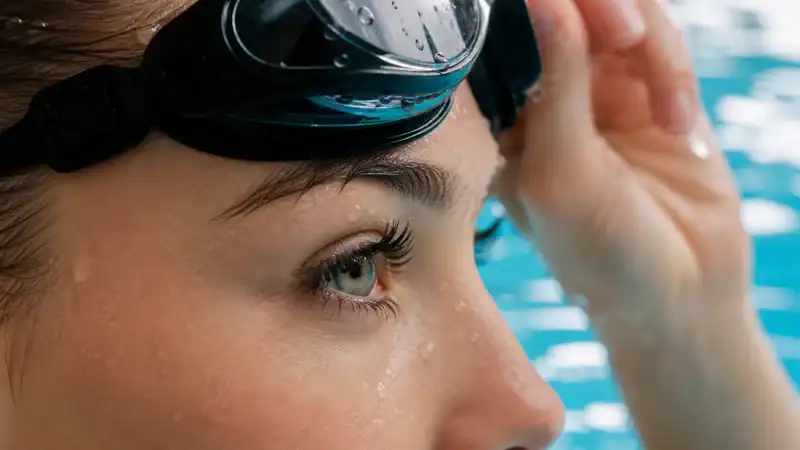
How Oxidizing Agents Break Down Keratin in Natural Lash Fibers
Here’s the part that surprised me when I first read it: chlorine (specifically hypochlorous acid, the active form in pool water) is chemically the same family as hair bleach.
Same type of reaction. Just lower concentration and longer exposure time.
What it does is attack the disulfide bonds in the keratin protein chains that make up your lash hairs.
Those bonds are what give lashes their structure, elasticity, and curl shape. Repeated oxidation disrupts the protein chain at those bond sites – and over time, the fiber becomes brittle, loses moisture, and loses curl retention.
This is why long-term regular swimmers sometimes notice their natural lashes feel more fragile or straighter than they used to – it’s not just the mechanical pressure from the goggles.
Keratin is the structural protein that forms hair and lash fibers, as documented by the Cleveland Clinic, and the chemistry applies directly to the keratin in your lashes.
One thing I’ll flag, because I’ve seen this come up: chlorine at pool levels doesn’t cause eye infections or corneal damage. That’s a different mechanism. What we’re talking about here is purely the effect on the lash fiber itself – keratin degradation from repeated oxidation.
Why Chlorine Eats Through Extension Adhesive Faster Than You’d Think
For extension wearers, the chemistry is different but the result is the same kind of problem: the bond degrades faster than it should.
Cyanoacrylate adhesive – the glue your lash tech uses to attach extensions – relies on an ester bond. That ester bond is vulnerable to hydrolysis, which is essentially the bond breaking down in the presence of water.
Pool water’s chlorination accelerates that hydrolysis relative to plain fresh water.
This is why swimmers who get lash extensions done and then swim regularly notice their extensions shedding noticeably earlier than friends with the same appointment interval who don’t swim.
💡 Quick Tip
Waterproof mascara contains oils that soften cyanoacrylate adhesive. Skip it entirely when you’re wearing extensions – before and after swimming.
The Goggle That Won’t Crush Your Lashes
This isn’t really about brand preference. I used to shop for goggles the way I shop for most gear – read reviews, pick a well-known name, and hope for the best. What I didn’t understand until I started paying attention to my lashes was that the property that matters is cup geometry, not brand reputation.
Specifically: cup depth. That’s the measurement that determines whether your lashes contact the lens.
A shallow-cup goggle presses its lens surface close to your lash line. A deep-cup goggle sits the lens assembly up and away from the orbital bone contact point – which means there’s actual physical space between the lens and your lashes, even if your lashes are on the longer side.
The good news is that several confirmed models have this geometry.
The less obvious news is that cup depth alone isn’t the whole answer – nose bridge sizing and strap tension both affect whether that depth actually protects you in practice.
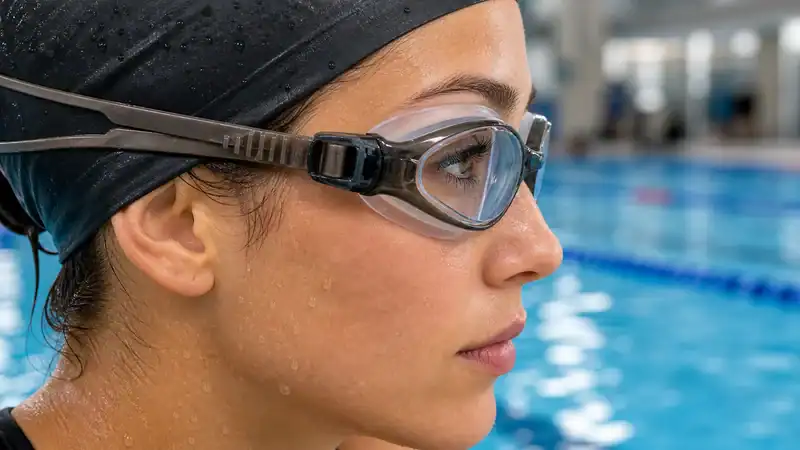
Cup Depth Is the Measurement That Matters – Not the Brand
“Deep-cup” isn’t a marketing category. It’s a geometry specification.
Specifically: the lens assembly sits elevated from the orbital gasket, creating physical space between the lens surface and the lash line when the cup seals on the orbital bone – not on your lash line, not on your eyelid. On the bone.
The models I know work for this geometry are: Speedo Vanquisher 2.0, Arena Cobra Core, Aqua Sphere Lady Kaiman, and TYR Socket Rocket 2.0. All four are confirmed deep-cup designs with raised lens assemblies.
That said, the pre-purchase test matters more than the model name.
Here’s the test – do this at the store or at home if you’ve ordered online. Hold the goggle against your face without the strap. Just press it gently to your orbital socket. If your lash tips contact the lens surface before the gasket reaches the bone, the cup is too shallow. Simple as that, at least in my experience.
📹 Video Quick Recap:
- Cup depth is the primary criterion – not brand or price
- Nose bridge sizing affects cup position and lash clearance
- Swim masks are a real alternative for high-extension volume cases
The Nose Bridge Trick That Moves the Cup Away from Your Lash Line
This one is practical guidance – not clinically proven, but it’s the kind of thing you discover after enough frustrated goggle sessions, and it tracks logically once you understand the geometry.
Many swimmers with long lashes find that sizing up one nose bridge notch shifts the cups just enough to clear the lash line entirely.
The nose bridge controls the lateral position of the cups relative to your face. Size up, and the cups shift outward and slightly away from the center – which, depending on your anatomy, can move the cup position from “lash contact” to “just barely clear.” Your mileage may vary.
Self-test: after goggle placement, look straight ahead and blink slowly. If you can feel lash tips on the lens, try the next larger nose bridge size before you adjust anything else. If your goggles have a fixed nose bridge, this won’t apply – which is a real limitation and worth knowing before you buy.
The article finding goggles that fit is primarily about kids, but the nose bridge sizing principles apply broadly across all face sizes and are worth reading if you’re trying to dial in fit.
Strap Tension Sets the Seal – Too Tight Means Contact
This one surprised me. I used to pull my goggle straps tighter than necessary, thinking a tighter seal meant better waterproofing. It doesn’t. It actually makes lash contact worse.
Here’s why: over-tightening forces the cup rim to flex inward and downward under the tension. That flexing reduces the internal clearance the cup geometry was designed to provide.
Correct tension is snug enough to hold a watertight seal without pulling into suction. Here’s a benchmark that works: press the cup to your orbital socket, release the strap, and see how long the goggle stays in place.
If it holds for 3-5 seconds without strap force, you’ve found your maximum tension. Tighten just enough beyond that to maintain the seal while swimming.
For the technical side of seal troubleshooting: fix your goggle seal and bungee vs. silicone straps are worth reading if you’re still getting water in even at the right tension.
Before You Get In the Pool – The Prep Protocol That Actually Prevents Damage
What you do before getting in the water differs quite a bit depending on whether you have natural lashes or extensions.
Most swimmers skip pre-swim prep entirely. I did for years. The thing is, for natural lashes the protocol is genuinely simple – there’s not much to do. But for extension wearers, the pre-swim routine is the single highest-leverage thing you can do for your retention between appointments.
The dual-track split here is deliberate. Natural lashes and extensions have different vulnerabilities, different materials, and different preparation needs. Combining them into a single routine tends to give advice that’s either overkill for natural lashes or dangerously incomplete for extensions.
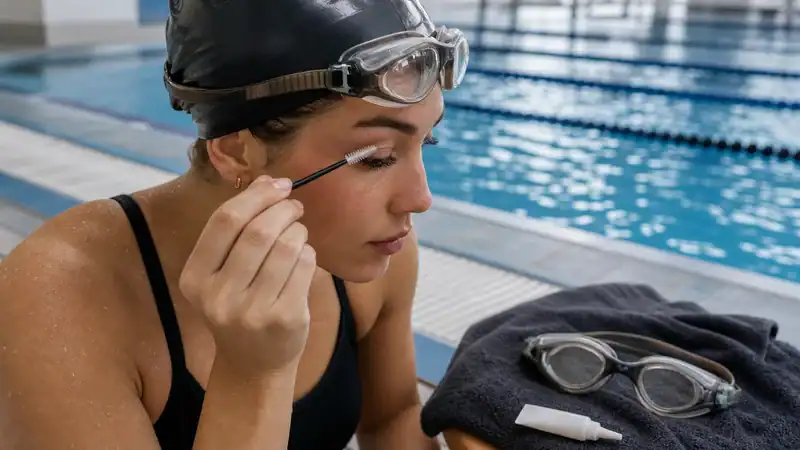
What to Leave Off Your Lashes Before the Pool
For natural lashes, the protocol is mostly about what NOT to put on – not a sealant or product routine.
Waterproof mascara is fine in the pool. The water-resistant polymer coating doesn’t clump or migrate the way regular mascara does. If you normally wear mascara and want to keep it on for your swim, waterproof is the only type that’s appropriate.
Regular mascara is a problem. It clumps when wet, and clumped mascara migrating near your eye is a physical irritant – not an eye infection risk in healthy eyes, but uncomfortable and potentially irritating to sensitive eyes. Leave it off.
Oil-based eye makeup is the bigger concern. Oils dissolve in water and migrate toward the eye, and they coat the lash fibers themselves – which actually increases the surface for chlorine to bind to. Leave it off.
The reassuring part: you don’t need a sealant product for natural lashes. The keratin fiber structure doesn’t require a hydrophobic coating to function.
A simple no-oil-makeup policy is enough.
Extensions Need Sealant, Timing, and the 48-Hour Rule – In That Order
The 48-hour rule comes first, because everything else is secondary if you get this wrong.
Cyanoacrylate adhesive requires full cure before water exposure. Swimming before 48 hours post-appointment significantly accelerates bond failure – the adhesive hasn’t fully cross-linked yet, and the combination of water pressure and chlorine chemistry at that stage is genuinely damaging.
LashLift USA documents this as a firm professional standard, not a soft recommendation.
After the 48-hour window clears, here’s the pre-swim protocol for every session:
- Apply nano-bond lash sealant to dry, clean extensions.
- Use a spoolie to distribute evenly from base to tip.
- Allow 2-3 minutes to dry completely before goggle placement.
That’s the full sequence. The sealant creates a hydrophobic barrier over the cyanoacrylate bonds, slowing the chlorine hydrolysis process. It won’t stop it entirely, but it meaningfully extends retention between appointments.
📹 Video Quick Recap:
- Pre-swim sealant creates a moisture barrier over the adhesive bond
- Goggle placement on the orbital bone prevents crushing and lash contact
- Post-swim rinse within 10 minutes stops chlorine from continuing to work on the lash surface
💡 Quick Tip
Oil-based eye products – makeup remover, certain mascaras – are incompatible with cyanoacrylate adhesive. Avoid them before swimming, not just on swim days. Any residual oil on the lash line degrades the adhesive bond over time.
The timeline to lock in: sealant – dry – goggles – swim.
How to Put on Goggles Without Catching Your Lashes (Step by Step)
Most lash damage from goggles doesn’t happen while you’re swimming. It happens in the two seconds it takes to put them on.
I figured this out the hard way after noticing that my extensions were getting bent and snagged specifically around the goggle placement moment – not from the swim itself. Once I started paying attention to how I was putting goggles on, the issue mostly stopped.
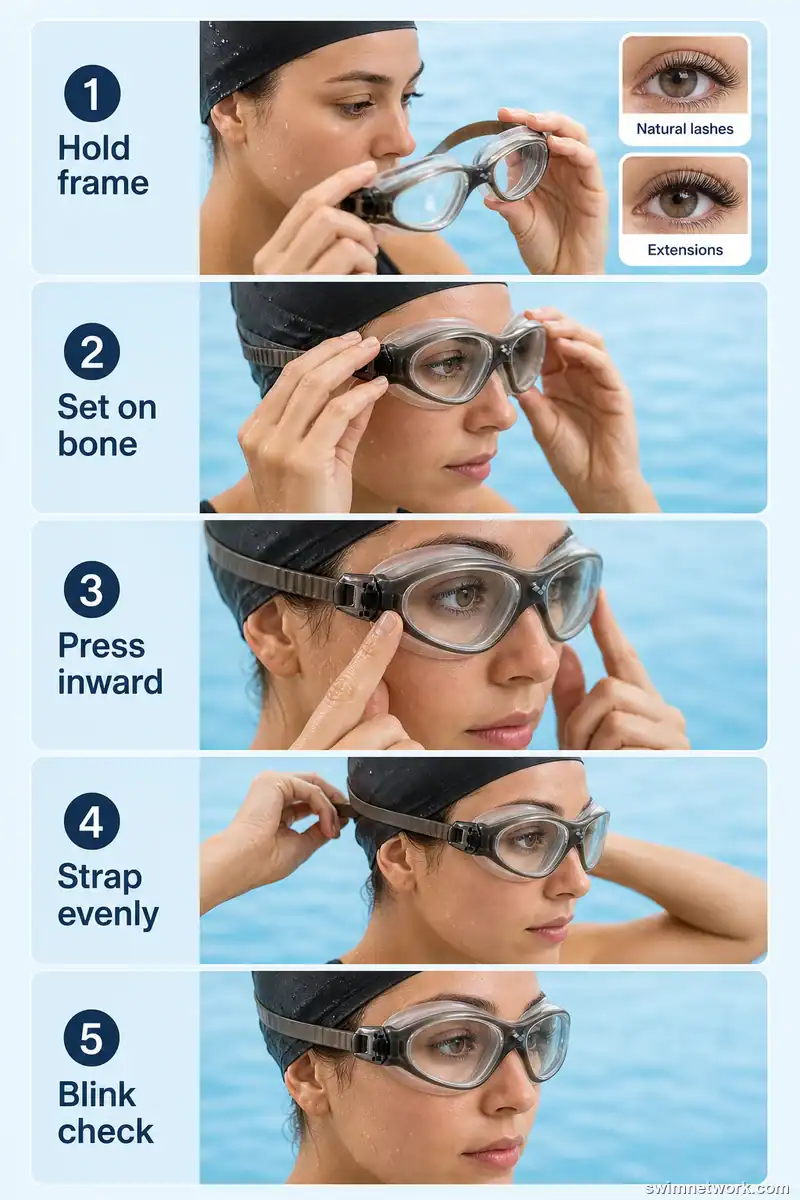
The key is placing the cup on the orbital bone – the bony ridge above your eye socket – before any strap tension is involved. Here’s the full sequence:
- Hold the goggle by the frame – not the strap. Holding by the strap changes the angle of approach.
- Position the cup rim on the orbital bone – the ridge above the eye socket, not on the lash line and not on the eyelid.
- Press down and inward with gentle, even pressure until you feel the gasket seal around the full orbital rim.
- Bring the strap over the head – pull gently from both sides simultaneously to avoid lateral shift that could drag the cup rim across your lash line.
- Check clearance – look straight ahead. Blink. If you feel lash contact, adjust the nose bridge size or reduce strap tension before you continue. Do not start swimming with contact.
One specific note for extension wearers: resist the instinct to check the seal by pulling the goggle outward from your face. That outward pull is exactly the motion that catches and pulls extension lashes. Instead, press gently around the rim – you’ll feel if the seal is solid.
The AI Overview summary of this process covers “goggle frame placement on orbital bone” in a single bullet. This sequence is what that actually looks like when you do it step by step.
What to Do Within 10 Minutes of Getting Out of the Pool
Chlorine doesn’t stop working the moment you leave the pool – it keeps oxidizing on your lash surface until you rinse it off.
This is the part I skipped for years because it felt unnecessary. I’d finish a session, shower, and not think about my lashes specifically.
What I eventually understood – from lash professionals, not from guessing – is that rinsing within about 10 minutes is what most professionals recommend for both natural and extension wearers.
It’s inference-based guidance, not a clinical study. But the logic is sound: the longer oxidation continues on the lash surface after swimming, the more cumulative wear you accumulate per session.
And while you’re at it, the same window applies to the rest of your skin and hair: protect your hair and skin from chlorine covers the full post-swim rinse routine.
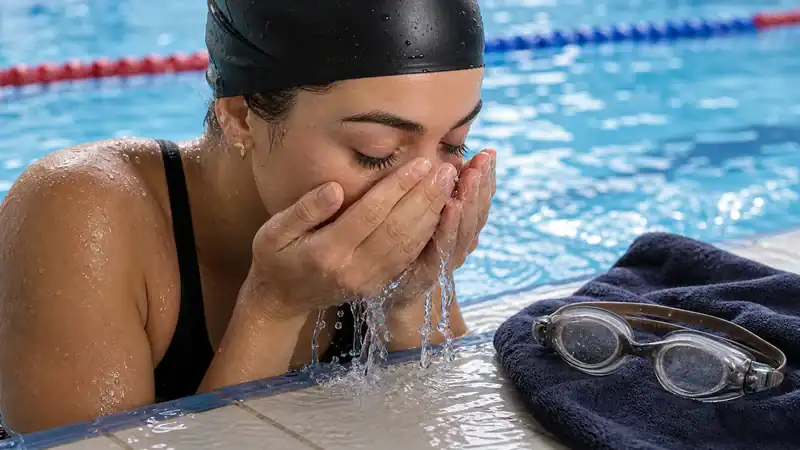
Natural Lashes Just Need Three Steps – and Done Means Done
The natural lash post-swim routine is short by design. Three steps, and you’re done.
Step 1: Rinse fresh water over closed eyes and your lash line. Thirty seconds is enough – you’re removing surface chlorine, not deep-cleaning.
Step 2: Pat dry with a clean, soft cloth. Never rub. Here’s the thing most swimmers don’t realize: mechanical friction is the primary cause of natural lash loss after swimming, not the chlorine alone. Wet, softened lash fibers plus rubbing equals breakage. Pat only.
Step 3: Air dry. If you normally wear mascara and want to reapply, wait until your lashes are fully dry.
Natural lashes don’t need a product routine. The simplicity here is intentional.
With Extensions, the Post-Swim Order Matters More Than the Steps
The order you do this in matters as much as what you do. Get the sequence wrong and you undo everything else you did correctly.
Here’s the correct sequence:
- Rinse immediately with cool fresh water – do NOT rub. Cool water, not hot.
- Pat dry gently with a lint-free cloth – top of lash to tip, not side to side.
- Do NOT brush while wet. This is the mistake that causes the most premature lash loss. Cyanoacrylate adhesive is partially softened by water. Brushing wet lashes applies mechanical force to a softened bond – you’re pulling on the weakest version of the adhesive. Wait.
- Once completely dry, brush with a clean spoolie from mid-lash to tip. Not from base. Mid-lash to tip.
Following this order preserves your curl pattern through multiple swim sessions.
💡 Quick Tip
The no-brush-while-wet rule is the single most common mistake and the most impactful to fix. Most extension wearers I’ve talked to didn’t know the adhesive was temporarily softened by water. Now you know.
When a Swim Mask Makes More Sense Than Goggles
If you’ve already tried deep-cup goggles, dialed in your nose bridge sizing, checked your strap tension, and you’re still experiencing lash contact – the next step isn’t more goggle adjustments. It’s a swim mask.
A swim mask works differently from goggles in one fundamental way: the seal extends around the entire eye socket rather than pressing against the orbital rim. That geometry moves all contact points away from the lash line entirely.
There’s no orbital bone placement required because the silicone skirt seals against your forehead and cheekbones, not around your eyes.
Swim masks vs. goggles covers the full comparison in detail – worth reading if you’re considering the switch.
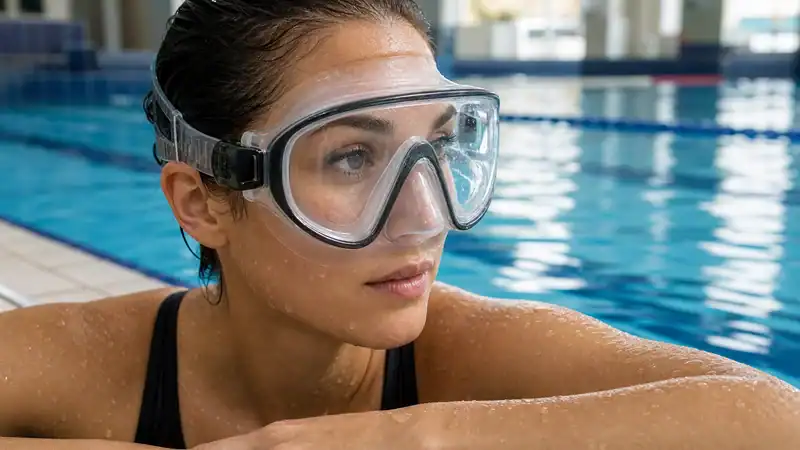
The honest trade-off is drag and bulk. Swim masks are significantly larger and create more frontal resistance than goggles. At a competitive pace or during structured lap sessions, that’s a real disadvantage. And honestly… for hard training sets, most people will want to stick with properly fitted goggles.
Where swim masks make real sense:
- Casual pool swimming – leisure laps, water aerobics, non-competitive sessions
- Snorkeling – the mask is already the right tool; lash protection is a bonus
- Open water – casual ocean swimming where drag matters less than comfort
- High-volume extension sets – very dense or unusually long extension sets may contact any goggle lens regardless of cup geometry; a mask is the escalation path
Swim masks reduce water exposure significantly – though no goggle or mask guarantees zero contact in rough water.
The Lash and Goggle Questions I Get Every Session
What swim goggles don’t touch your eyelashes?
Deep-cup goggles are the primary category to look at – specifically: Speedo Vanquisher 2.0, Arena Cobra Core, and Aqua Sphere Lady Kaiman. All three have a raised lens assembly that creates clearance between the lens surface and the lash line.
That said, no goggle universally “doesn’t touch” lashes. Cup geometry plus the correct nose bridge size plus the right strap tension together determine whether you get clearance or contact.
The pre-purchase test that works: hold the goggle to your face without the strap and check whether your lash tips reach the lens. If they do, the cup is too shallow – or the nose bridge size needs adjustment.
Is chlorine bad for your eyelashes?
Yes – repeated exposure is harmful to both natural lashes and extensions, through different mechanisms.
For natural lashes: chlorine oxidizes the keratin protein chains in your lash fibers, causing brittleness and loss of curl retention over time. The Cleveland Clinic documents this chemistry for hair fibers, and the same mechanism applies to lash keratin.
For extensions: chlorine accelerates cyanoacrylate adhesive hydrolysis, shortening how long your retention lasts between appointments. This is the primary reason frequent swimmers see their extensions shed earlier than non-swimmers on the same appointment schedule.
Chlorine at pool levels doesn’t cause eye infections or corneal damage – that’s a different mechanism. The concern here is specifically the cumulative effect on the lash fiber and adhesive.
How long should I wait to swim after getting lash extensions?
Wait at least 48 hours after your appointment before swimming.
Cyanoacrylate adhesive requires a full cure before water exposure. Swimming before the 48-hour mark significantly increases premature lash loss because the adhesive hasn’t fully cross-linked. Lash professionals – including LashLift USA – document this as a firm standard, not a soft recommendation.
Can I use a lash sealant before swimming?
Yes – for eyelash extensions, a nano-bond lash sealant applied before each swim session creates a hydrophobic barrier that slows adhesive degradation from chlorine.
Important to note: sealant is for extensions, not natural lashes. Natural lash keratin doesn’t require a coating.
Application: apply to dry, clean extensions with a spoolie; distribute evenly from base to tip; let dry 2-3 minutes before goggle placement. The detailed protocol is in the “Before You Get In the Pool” section above.
Can you swim with a full-face swim mask instead of goggles?
Yes – swim masks are a viable alternative, especially for extension wearers who continue experiencing lash contact with properly fitted goggles.
The key difference is the seal geometry: a swim mask seals around the full orbital socket via a silicone skirt against the forehead and cheekbones, rather than pressing against the orbital rim. This moves all contact points away from the lash line entirely.
The trade-off: swim masks are bulkier and less practical for lap swimming. They’re better suited for casual pool use, snorkeling, or open water swimming. See the “When a Swim Mask Makes More Sense” section for the full use-case breakdown.
Do swim goggles damage eyelash extensions if you wear them every day?
Yes – daily goggle use accelerates extension wear if the fit is incorrect. The three main culprits are insufficient cup depth, excessive strap tension, and donning technique that causes mechanical contact at the moment of placement.
With correct goggle geometry, adjusted nose bridge sizing, and the proper orbital bone placement technique, daily swimming with extensions is manageable for many swimmers.
But “manageable” isn’t “zero impact” – the cumulative chemical effect of daily chlorine exposure still adds up, even with good goggles and a sealant routine.
Daily swimmers with extensions should expect to schedule appointments more frequently than non-swimmers. That’s the honest picture.
Your Lashes Will Survive the Pool – If the Goggle Does Its Job
Most lash damage from swimming is preventable. The right goggle geometry, the right nose bridge size, the right strap tension, the pre-swim sealant, the 48-hour wait, the post-swim rinse before you do anything else – none of it is complicated. It just has to be done in order.
The part that took me a while to accept is that “right” isn’t a single goggle or a single routine. It takes a few sessions to dial in what actually works for your lash length, your extension volume, and your face geometry.
Someone with a very narrow nose bridge will have a different answer than someone with a wider set. That’s not a problem with the advice – it’s just how fit works.
If you’re working through goggle selection from the beginning, our full swim goggle selection and fit guide covers seal testing, nose bridge sizing, strap type, lens options, and when to replace a pair in one place.
What I can’t promise is that even a dialed-in routine holds perfectly. Very long or very dense extension sets will see some attrition in a regular swim schedule – the chemistry is cumulative and there’s no way around that entirely. A good goggle and a good routine reduce the rate of attrition. They don’t eliminate it.
Whether that’s acceptable depends on how much you swim. That part is up to you.
Disclosure: This article features AI-assisted imagery to help provide a more intuitive and visual reading experience.

 Your Eyes Are Burning – But It’s Not the Chlorine You Think
Leave a Reply