
A 2021 fluid dynamics study of one elite swimmer’s head model found that three tested goggle designs reduced total head drag by 4% to 9% compared with the no-goggle condition. The Swedish design produced the lowest total drag in that simulation.
That’s not a marketing claim. It comes from a peer-reviewed CFD simulation published in Sports Biomechanics, and it’s the first evidence I reach for when a swimmer asks me whether competitive racing swim goggles actually do anything.
The real question is: are they engineered differently, or just priced differently?
After years of coaching and working through what the research actually says – I can tell you it’s the engineering. The socket fit, the gasket depth, the nose bridge, the strap system, the lens profile – these are different by design.
This article covers the five mechanical differences that separate racing goggles from training goggles, what the drag evidence actually measures, and how to apply that to the decision you’re making.
🏊 Quick Summary – Key Takeaways
- Racing goggles seat inside the orbital rim (the eye socket itself), not on the orbital bone like training goggles – this creates a suction-based seal that holds through block-start dives.
- In one elite swimmer’s head model, three tested goggles produced 4% to 9% less total head drag than the no-goggle condition. That’s a modeled head-drag result, not a time-saved guarantee.
- A 2020 review found double straps on 69% of 26 sampled commercial goggles. The design provides two tension points, but that paper did not test start or turn retention.
- Mirrored, clear, and curved lens choices address optics and swimming conditions; the cited drag research concerns goggle fit and external profile.
- Swedish goggles have no gasket at all – the lens cups sit directly on the socket rim, making them the design-logic extreme of the racing category.
⚠️ Safety Disclaimer & Target Audience
Best for: Competitive swimmers, coaches, and swim parents comparing racing-goggle engineering, fit, and lens choices.
Not ideal for: Anyone choosing goggles for a diagnosed eye condition or persistent eye pain; those decisions require qualified eye-care guidance.
Racing Goggles Are a Different Category of Equipment
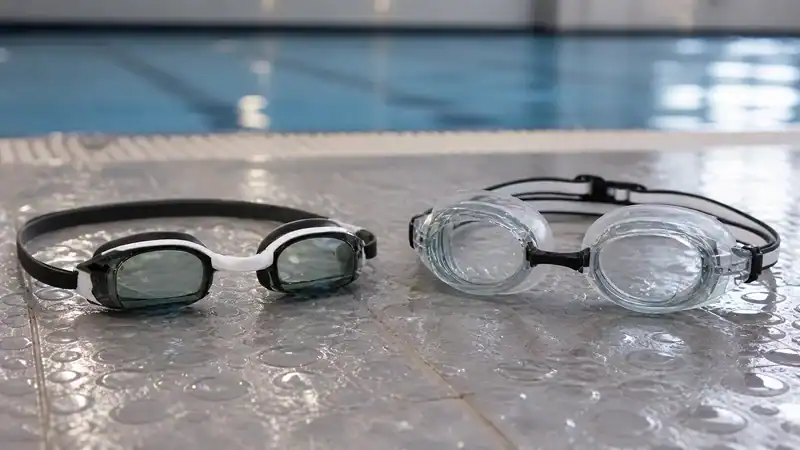
The difference between a racing goggle and a training goggle is not about color or price. It’s about where the lens sits on your face.
Racing models such as the Speedo Fastskin Pure Focus or Arena Cobra Ultra Swipe generally use a low-profile inner-eye fit. Many training and comfort goggles use an outer-eye fit on the orbital bone, the bony ridge around the socket.
That contact-point difference changes the seal mechanism, external profile, and race-start fit.
When an inner-eye racing goggle seats correctly, its cup and gasket can hold briefly through negative pressure. The strap retains the goggle during movement, but overtightening should not be required to create the seal.
An outer-eye training goggle uses a thicker gasket that compresses against the orbital bone. Both approaches work, but they prioritize different contact areas and wearing conditions.
If you’re comparing beginner and training swim goggles to racing models, the gap isn’t a marketing line. It’s an engineering decision made from the first measurement.
What Researchers Found When They Measured 26 Commercial Goggles
In 2020, Park et al. published an analysis of 26 commercial swim goggles, cataloging structural features in that sample. The numbers are worth reading carefully.
Only 31% of the 26 goggles listed a hydrodynamic design feature. In the same sample, 69% used double head straps and 50% had an exchangeable nose bridge.
The researchers purchased five of those goggles for dimensional measurement. Across those five, average gasket depth was 10.0 mm.
That 10.0 mm average describes five measured products, not the entire market. Dual straps and exchangeable bridges were common in the 26-product sample, but the paper did not test whether either feature prevented leaks or improved race-start retention.
These aren’t marketing categories. They’re measured structural patterns, and they map directly to the five engineering differences we’ll break down next.
The Drag Numbers Are Real
A 2021 fluid dynamics simulation put actual numbers on what goggles do to drag.
Computational Fluid Dynamics – CFD – is a method for modeling water flow around an object using numerical simulation. No pool is required for the simulation itself.
Researchers build a 3D model of the swimmer’s head and goggle geometry, define water velocity and flow conditions, and let the software calculate the forces. The same numerical approach is used in other engineering fields and can be applied to swim equipment.
The study tested how different goggle types affected total hydrodynamic resistance. The results gave us the first peer-reviewed drag numbers for competitive swim goggles.
What CFD Research Measured
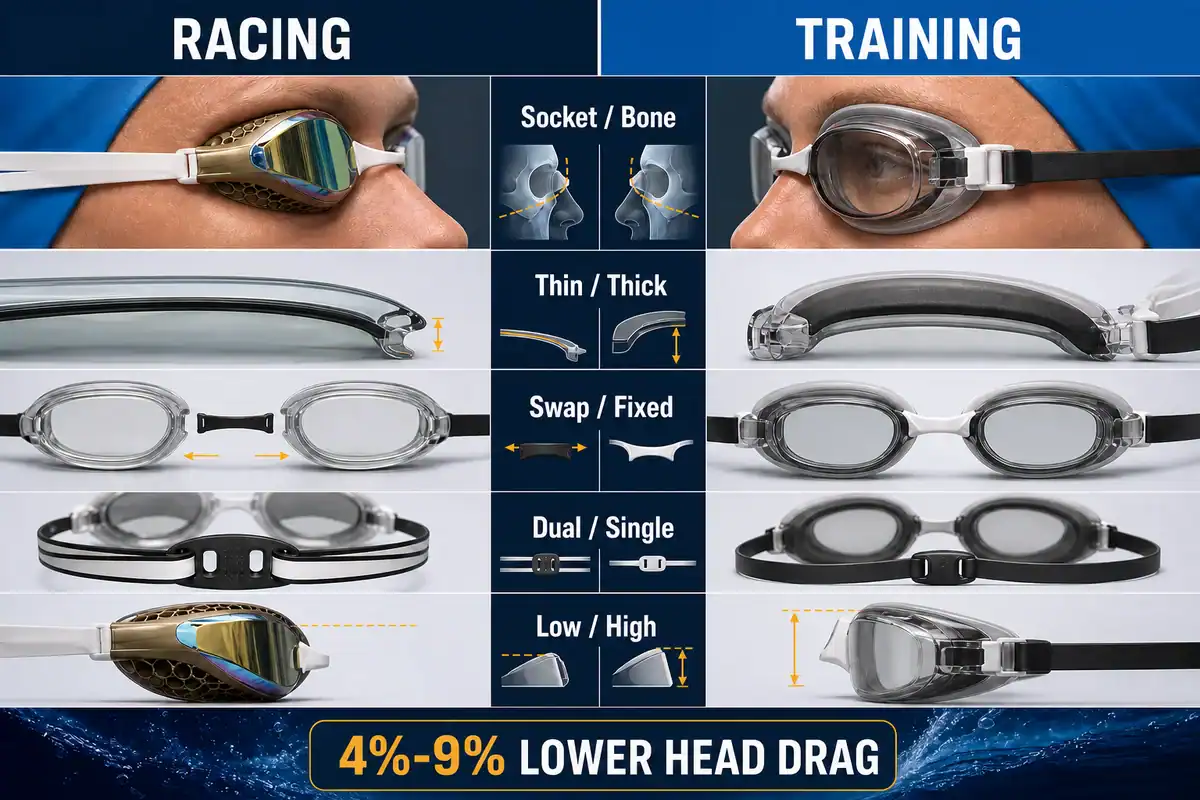
A 2021 fluid dynamics simulation in Sports Biomechanics tested Swedish, Nikko, and Ankor goggles on one elite swimmer’s scanned head model at 2 m/s. Total head drag was 12.99 N without goggles, 12.51 N with Ankor, 12.40 N with Nikko, and 11.83 N with Swedish goggles.
That equals approximately 4% to 9% less total drag on the head model, with Swedish goggles producing the lowest total drag of the three designs tested.
The simulation measured hydrodynamic resistance on the head model. It did not measure time saved, energy cost per meter, full-body drag, or race outcome.
It also used one participant and one head position, so the exact percentages should not be generalized to every swimmer or goggle.
What the simulation does establish is that goggle geometry can change modeled head drag. It does not establish that every low-profile model will reproduce the same reduction.
💡 Coach’s Bottom Line
The simulation found 4% to 9% lower total drag on one swimmer’s head model, depending on goggle design. It does not turn that result into a guaranteed time drop.
Five Engineering Differences That Separate Racing From Training
Each of the five differences below is a deliberate engineering decision, not a styling choice. Racing goggles aren’t training goggles with a different logo.
The internal geometry, gasket, nose bridge, strap system, and lens profile are built differently on purpose. Models express those choices differently: the Speedo Vanquisher emphasizes inner-eye fit, while the MP Ninja uses curved lenses to widen peripheral view.
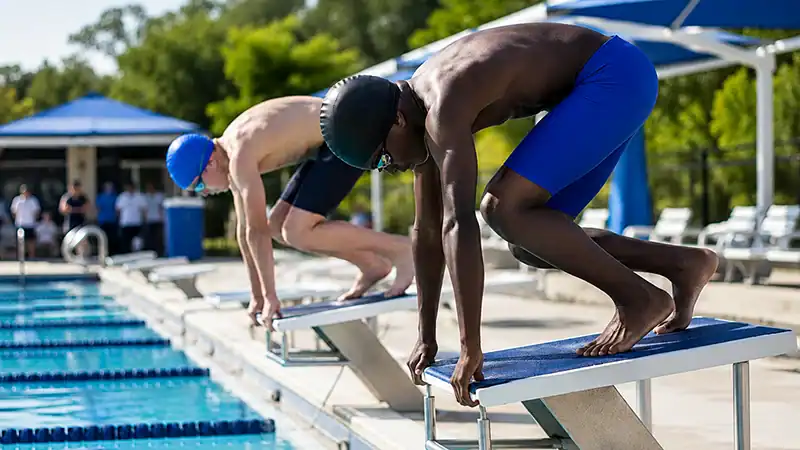
Where the Lens Sits on Your Face
There are two contact zones on your face where a goggle can seal: inside the orbital rim, or on the orbital bone.
The orbital bone is the bony ridge that forms the frame around your eye socket. Many training and comfort goggles seal on this wider outer-eye area.
Their gaskets distribute pressure across a broader surface and create a compression seal. That design generally favors comfort during longer practice sets.
Low-profile racing goggles typically seal inside the orbital rim. The cup geometry uses a smaller contact area and negative pressure to create the seal.
That fit can feel more concentrated than an outer-eye training gasket, so cup shape matters.
That initial suction should not require a tight strap. A brief strap-free suction test can show whether the cup shape matches the swimmer’s face before final adjustment.
The Gasket Is Thinner for a Reason
Racing goggle gaskets are typically thin silicone – and in some designs, like Swedish goggles, there’s no gasket at all.
A thinner gasket allows the lens cup to sit closer to the face. The seal depends more on cup geometry and even contact than on compressing a thick cushion against the orbital bone.
Less gasket depth also means less structure protruding from the face.
Training goggles often use a thicker, softer gasket. That gasket creates a broader compression seal on the orbital bone for longer wear.
The trade-off is a higher external profile and a different seal feel.
If leaks persist despite more strap tension, stop tightening and test gasket shape and bridge width first. See our breakdown of why goggles leak even when the strap is tight for a structured seal check.
The Nose Bridge You Can Swap Out
Half of the 26 commercial goggles in the 2020 Park et al. analysis included interchangeable nose bridges.
Nose bridge width helps determine whether both lens cups sit centered over your eyes. A bridge that’s too wide can pull the cups apart and open the seal at the inner edge.
A bridge that’s too narrow can shift the cups inward and distort contact in the opposite direction.
Interchangeable bridges let swimmers match lens spacing to their nose geometry. That precision matters when the goggles must hold through a start without readjustment.
The Speedo Vanquisher 2.0 is a common example because it ships with multiple bridge sizes. That is a fit-precision feature, not just a convenience.
Two Straps Instead of One
69% of commercial goggles in the 2020 analysis used double head straps.
A single strap creates one retention line across the back of the head. During a block start or flip turn, that line can migrate.
Two separated straps create two retention points and provide another point of contact if one band shifts.
Many competitive swimmers route their straps under the swim cap. The cap can help keep the straps from migrating or catching at the start.
It’s worth understanding whether to wear goggles over or under your swim cap before race day. If you’re deciding between strap types, the comparison of silicone vs. bungee straps covers the retention and durability trade-offs.
Olympic swimmer Cody Miller breaks down exactly why goggle selection and strap setup matter at race pace in this breakdown:
📹 Video Quick Recap:
- Low-profile designs like the Arena Cobra Ultra and Speedo Vanquisher lock onto the face at block starts without requiring strap over-tightening.
- Dual straps distribute tension independently – each strap holds position even if the other shifts during a flip turn.
- Goggles-under-cap is competitive standard: it eliminates cap-over-strap snagging at race starts and locks strap position mechanically.
Swedish Goggles Take the Racing Logic All the Way
Swedish goggles have no gasket. There is no foam or silicone seal ring.
The rigid lens cups sit directly on the eye socket rim, connected by a string-and-tube nose bridge assembly with no molded frame.
That construction takes the socket-fit design principle to its logical end point. Without a gasket, there is no soft seal ring between the lens cup and socket rim.
The contact is direct, and the external profile is minimal.
The same 2021 CFD study found that Swedish goggles produced 11.83 N of total drag on the tested head model, approximately 9% below the no-goggle condition and the lowest of the three designs.
💡 Coach’s Note
Direct socket contact can feel more intense than a padded gasket, and it is not the right fit for every swimmer. That trade-off helps explain what other low-profile designs soften with thin gaskets.
Solve Fit and Profile Before You Choose Lens Optics
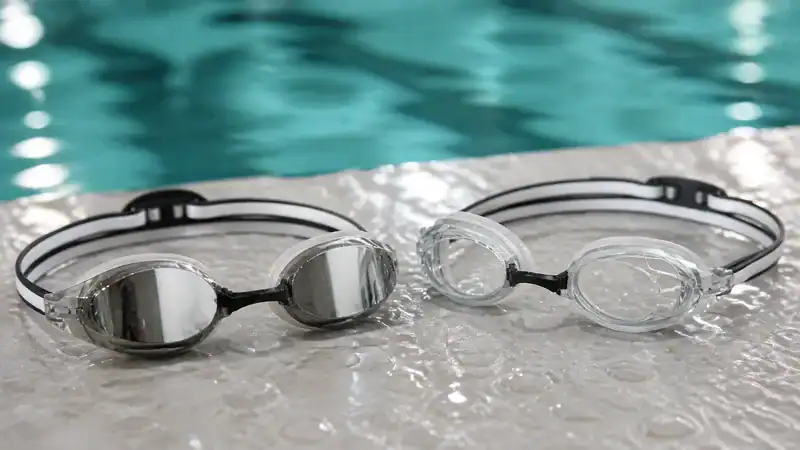
The cited drag research concerns goggle fit and external profile. Mirrored, clear, and curved lens choices answer optical and swimming-condition needs – they are a separate decision.
Get the socket fit and profile right first. Then choose your lens. If you are working through goggle selection from the beginning, our complete swim goggle selection guide covers fit, seal testing, lens types, straps, and care in one place.
Racing goggles often use factory-applied anti-fog coatings, and coating care affects how long the lens stays clear. Our guide to how long racing goggles typically last explains the replacement signals.
UV400 describes protection through 400 nanometers, covering UVA and UVB wavelengths; it is separate from whether a lens is mirrored or clear. Polycarbonate is a common racing-goggle lens material, but verify model-specific UV and coating claims rather than inferring them from tint alone.
Mirrored, Clear, and Curved Lenses Serve Different Conditions
Mirrored lenses use a reflective outer coating that reduces glare from overhead pool lights or outdoor sun. The tint and mirror finish are visibility choices, not evidence of a lower-drag frame.
Some competitive swimmers value that mirrored lenses hide their eyes before a start, but that is a practice observation rather than a documented psychological advantage.
Clear lenses omit a dark tint or mirror finish and generally transmit more available light. That makes them useful in dim indoor pools, early-morning sessions, and overcast conditions.
Curved lenses follow an arc rather than a flat plane. The shape can widen peripheral field of view without requiring as much head rotation.
The Arena Cobra Ultra is one racing example of this curved-lens approach.
Polarized lenses block horizontally-reflected surface glare – most useful in open-water or outdoor pools where surface reflection is the primary visual problem. They’re less common in racing-specific designs.
For a deeper breakdown of how each lens type performs across different swimming conditions – including the UV400 and polarization distinctions that matter most for outdoor and open-water racing – the lens type guide covers clear, tinted, mirrored, and polarized in full.
Justin Patrick walks through the practical decision between clear and mirrored in real pool conditions:
📹 Video Quick Recap:
- Mirrored coating reflects light outward – useful in brightly lit indoor venues or outdoor pools where glare disrupts focus.
- Clear lenses maximize light transmission – the right choice for low-light training pools or overcast outdoor conditions.
- Lens type is a visibility and conditions decision, separate from goggle fit and profile.
Three Things Swimmers Get Wrong About Racing Goggles
I hear the same questions every season. Some of them are misconceptions that send swimmers in the wrong direction – tighter straps, wrong goggle type, wrong expectation.
Here’s what actually happens in each case.
“Tighter straps equal a better seal.” They don’t.
The initial seal comes from even cup or gasket contact, while the strap provides retention during movement. Overtightening can distort that contact without fixing a shape or bridge mismatch.
If a goggle still leaks, test cup shape and bridge width before adding more strap tension.
“Racing goggles are just training goggles with a higher price tag.” They’re not.
Inner-eye placement, thin gaskets, split straps, and low-profile lens geometry are real structural differences, although not every model uses every feature. The CFD simulation did not compare racing goggles with training goggles; it compared three goggle designs with a no-goggle head model and found 4% to 9% lower total head drag.
A Speedo Vanquisher and a Speedo Biofuse use different fit profiles, so compare contact area and seal geometry rather than price alone.
“All racing goggles are the same.” The category spans a wide range.
Swedish goggles – no gasket, string nose bridge, direct socket contact – sit at one extreme. At the other end, designs such as the FINIS Smart Goggle add electronics to a performance-oriented frame.
The design philosophy may be shared, but racing is not a single construction specification.
The FAQ section below addresses the questions I get most – performance expectations, comfort concerns, meet rules.
The Racing Goggle Questions I Hear Every Season
Do racing goggles actually make a difference in performance?
The measured difference is mechanical, but the study does not establish a race-time benefit. The 2021 fluid dynamics simulation found 4% to 9% less total drag on one swimmer’s head model with the three tested goggles than without goggles.
That is a modeled head-drag result, not a percentage of time saved. It does not promise a faster race or quantify full-body drag.
Do racing goggles hurt more to wear than regular goggles?
Racing goggles can feel more concentrated because an inner-eye fit uses a smaller contact area. The seal should feel secure, not painful.
If discomfort appears quickly, remove the goggles and try a different cup, gasket, or bridge configuration instead of tightening the strap. Training goggles generally feel softer because their outer-eye gaskets spread contact across a wider area.
Are there rules about what goggles you can wear in a swim meet?
This research did not verify a goggle-specific World Aquatics rule or an official banned-goggle list.
Check the current governing-body rules and confirm equipment requirements with your meet organizer before race day. Meet-specific requirements may differ from general governing-body guidance.
Can I use training goggles for a swim meet?
This research did not identify a ban on standard training goggles, but confirm current rules with your meet organizer. Training goggles generally use broader outer-eye gaskets, while many racing designs combine inner-eye placement, thinner gaskets, and split straps.
Those racing features prioritize a low profile and stable retention at a block start. If you need vision correction, there are prescription racing goggles designed for competitive use.
Open-water and triathlon goggles form another contrast class, generally prioritizing a wider field of view and outdoor visibility over the smallest pool-racing profile.
Dan Swim Coach covers goggle care and setup specifics in this practical walkthrough:
📹 Video Quick Recap:
- Nose bridge width is the most common root cause of goggle leaks – not strap tension.
- Competitive standard: goggles under the swim cap locks straps and eliminates cap-snagging at race starts.
- Anti-fog care: rinse with cold water only, never rub the lens interior coating.
So, Are Racing Goggles Worth It?
For competitive swimmers who race regularly – yes. The fit, gasket, bridge, strap, and lens-profile differences are real design choices.
The drag evidence comes from a single-participant head-model simulation rather than a race-time trial. A racing goggle earns its place when its fit stays secure at starts and turns without excessive tension.
For recreational swimmers who compete occasionally – it depends. If you race a handful of times a year and your training goggles seal well through your starts, the upgrade is a lower priority.
The engineering matters more when the race matters more.
For pure training, training goggles often make more sense. They exist for a reason.
The thicker gasket and wider compression zone prioritize comfort during long sets. Racing goggles can still be used in practice, but their concentrated fit may be less comfortable over time.
Whether a 4% to 9% reduction in modeled head drag adds up to a visible time drop at your level… that depends on how consistent everything else is. The goggle is one variable.
But it’s one variable you can control.
Disclosure: This article features AI-assisted imagery to help provide a more intuitive and visual reading experience.

 The Best Swim Goggles for Beginners in 2026: 8 Picks for Adults and Kids
Leave a Reply